

Potthastia longimanus group
-
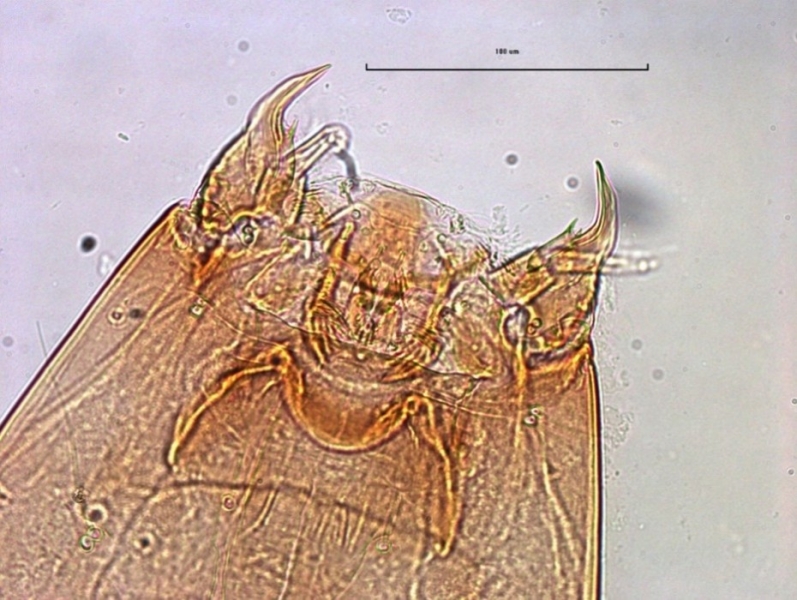
1/2
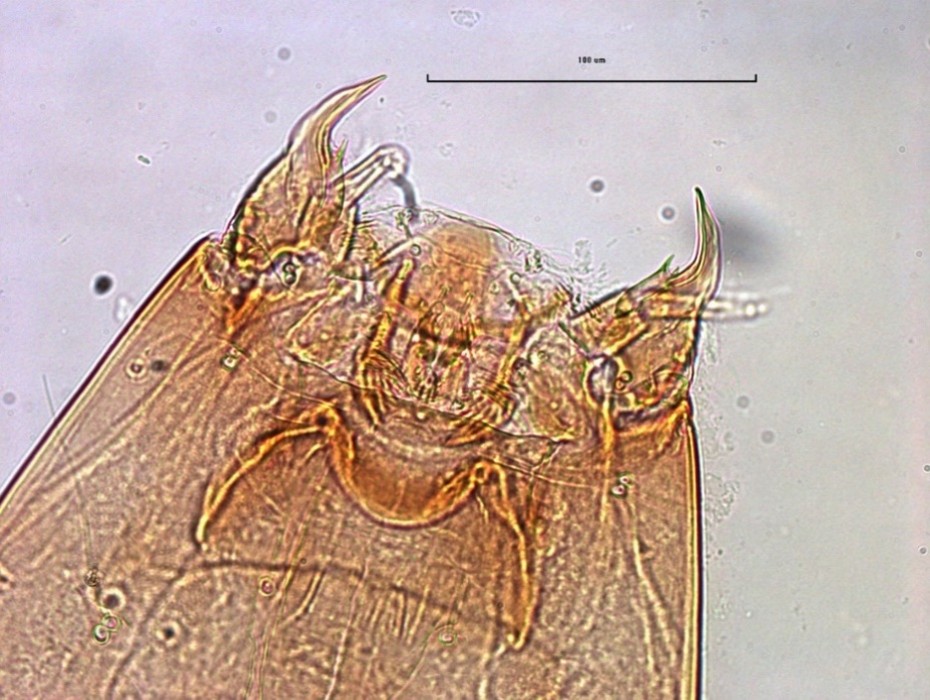
Figure 1. Potthastia longimanus group larva. Note the unique flat mentum area, void of any teeth and ventromental plates, as well as the long hook-like mandibles and the apically broad, finely toothed premandibles, typical of P. longimanus group. This individual was found in Lake Huron during the sampling in July 2022.
Download Image -
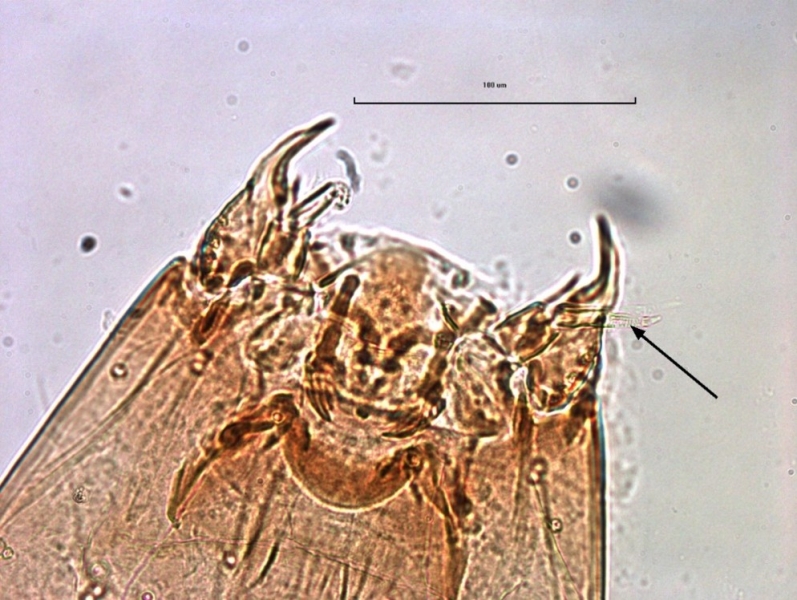
2/2
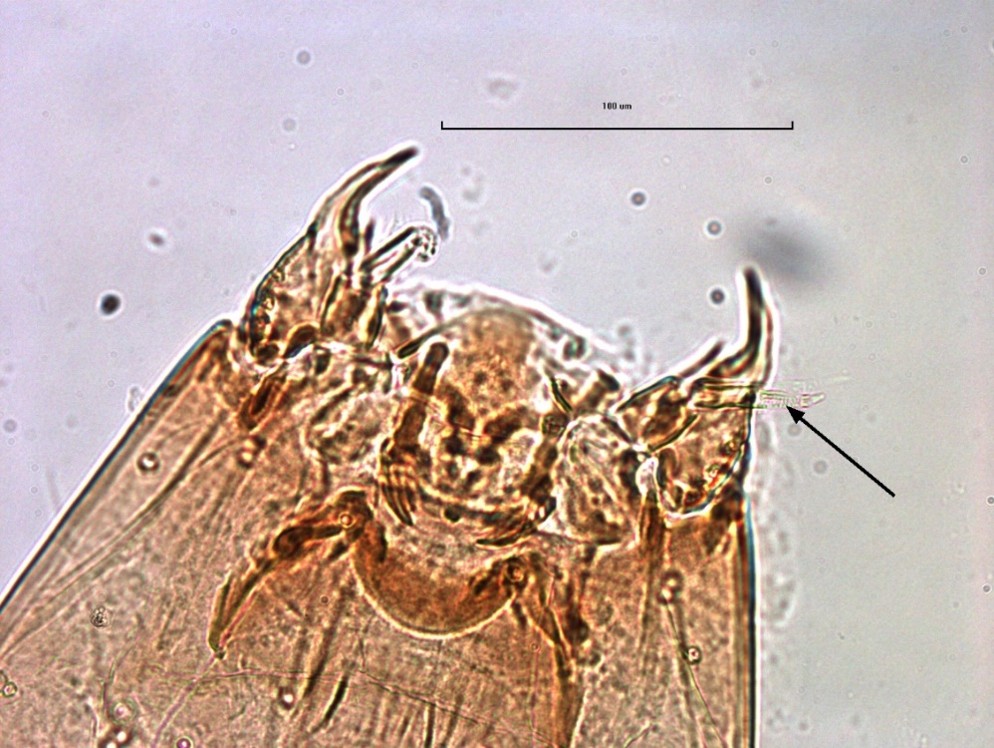
Figure 2. The arrow points to Potthastia longimanus group annulated third antennal segment. This individual was found in Lake Huron during the sampling in July 2022.
Download Image
Potthastia longimanus group
Taxa description
Potthastia longimanus group (Kieffer, 1922) is a medium to large-sized chironomid in the subfamily Diamesinae. This group is easily distinguished by the highly unique mentum lacking all teeth and ventromental plates, leaving a somewhat flat line where the mentum would usually be. Potthastia longimanus group has five segmented antennae with annulations on the third segment, typical of the subfamily. The antennal blade originates from the base of segment 2, as opposed to emerging half-way up the segment, differentiating it from the other group of this genus. This chironomid also possesses sharply hooked mandibles with very small inner teeth as well as apically broad, finely multi-toothed premandibles. Overall, the head shape is more ovular than rounded, giving the midge a more pointed appearance.
Distinguishing features
Habitat
P. longimanus group larvae inhabit flowing water of all sizes and lakes. They are generally associated with sandy substrates. are most frequently found in standing waters, but some species can inhabit both lotic and lentic ecosystems.
Lake occurrence
This species group occurs in all five Great Lakes.
Similar species
Relative size
Potthastia longimanus group larvae are medium to large, reaching lengths up to 10 mm.
Does it have a barcode reference from the Great Lakes?
References
Andersen, T., P.S. Cranston, and J.H. Epler. 2013. The larvae of the Chironomidae (Diptera) of the Holarctic Region. Insect Systematics & Evolution, Supplement No 66.
NOAA and US EPA. 2019 Great Lakes Waterlife. Accessed on 06/05/2026.
Epler, J.H. 2001. Identification manual for the larval Chironomidae (Diptera) of North and South Carolina.
Occurrence in scientific literature
Barton, D.R. 1988. Distribution of some common benthic invertebrates in nearshore Lake Erie, with emphasis on depth and type of substratum. J. Great Lakes Res.14, 34-43.
Fletcher, R., S. Baker, and S. Petro. 2007. Biomonitoring study of Thunder Bay Harbour in the vicinity of Cascades Fine Paper. Water Monitoring and Reporting Section and Environment Monitoring and Reporting Branch report, Thunder Bay.
Glass, W.R, N.E. Mandrak, and M.A. Koops. 2014. Application of the Ecologically Significant Species Criteria to the aquatic community of the Bay of Quinte, Lake Ontario. DFO Can. Sci. Advis. Sec. Res. Doc. 2014/043. v + 32 p.
Nalepa, T. F., D. L. Fanslow, M. B. Lansing, and G. Lang. 2002. Abundance, biomass, and species composition of benthic macroinvertebrate populations in Saginaw Bay, Lake Huron, 1987-96. Great Lakes Environmental Research Lab, Ann Arbor, MI, tech memo. GLERL-122.
Winnell, M. H., and D.S. White. 1985. Trophic status of southeastern Lake Michigan based on the Chironomidae (Diptera). J. Great Lakes Res.11(4), 540-548.