

Paratendipes albimanus
-
1/2
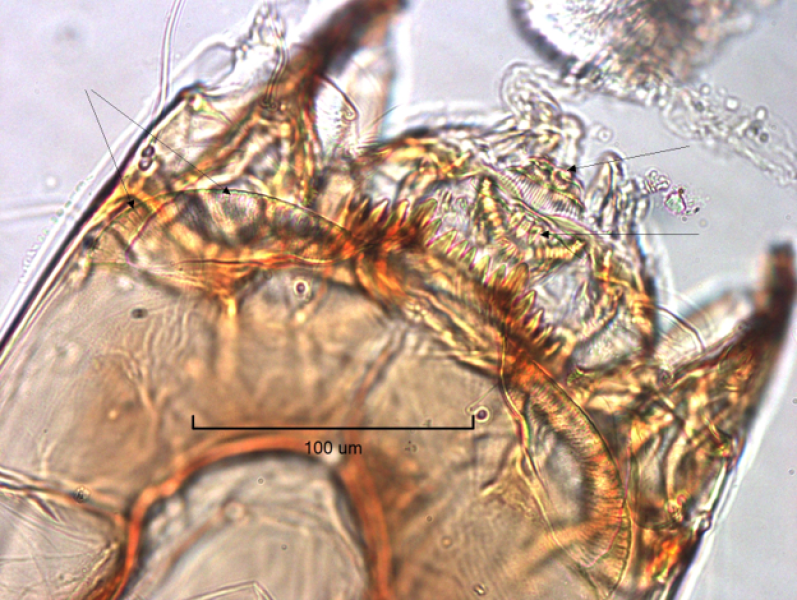
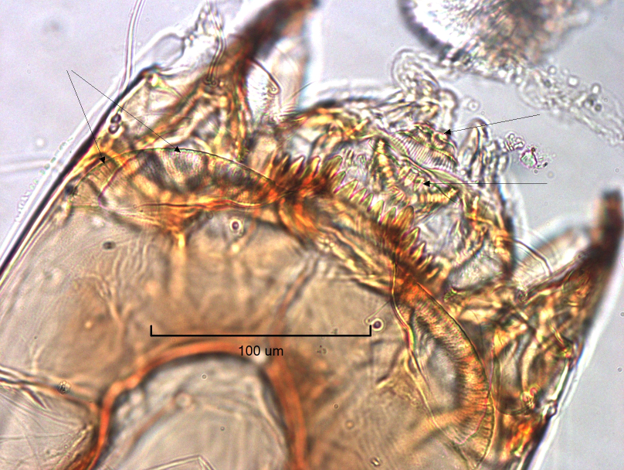
Figure 1. Head capsule of Paratendipes albimanus, note the pale median teeth of the mentum, the fused base of the S1 setae, striae of the ventromental plates, and pecten epipharyngis. This individual was found in Lake Huron during the sampling in July 2022.
Download Image -
2/2
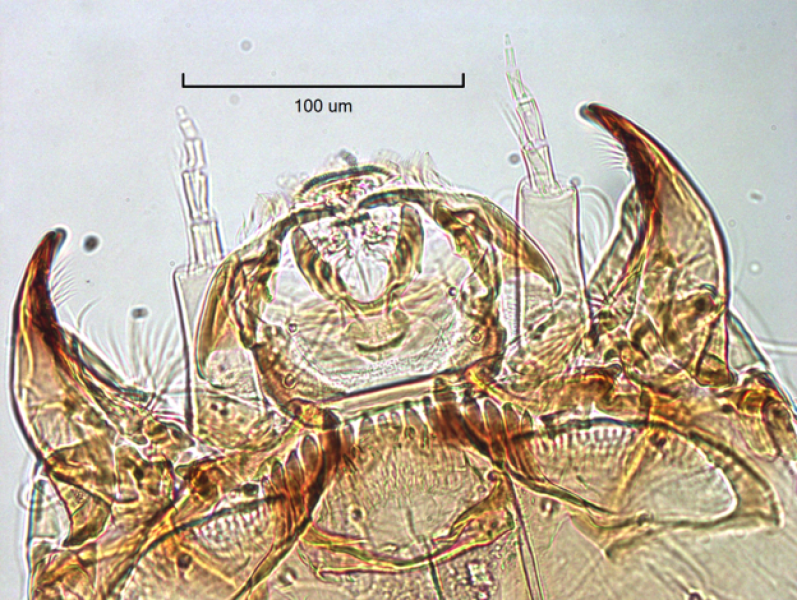
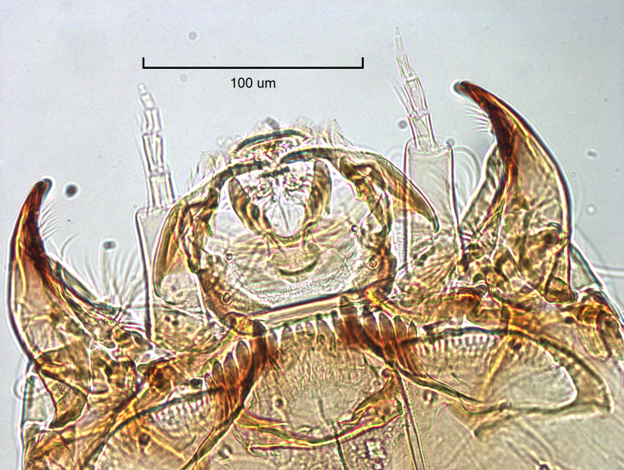
Figure 2. Head capsule of Paratendipes albimanus. Note the six segmented antennae with alternate lauterborn organs on segments two and three. This individual was found in Lake Huron during the sampling in July 2022.
Download Image
Paratendipes albimanus
Taxa description
Paratendipes albimanus (Meigen, 1919) is a chironomid in the Subfamily Chironominae. This species is easily distinguished by the unique mentum, having two small pairs of pale median teeth of equal length (Fig. 1), as well as the fused bases of the plumose SI. The central median teeth are lighter in color than the other lateral teeth. The first lateral tooth is fused to the larger, longer second lateral tooth and the overall mentum is not strongly arched. The ventromental plates are longer than wide and with coarse striae on the upper third of the plate, with no striae on the lower portion. P. albimanus has six-segmented antennae with Lauterborn organs on alternate sides of segments two and three, with the ring organ located on the proximal third of the basal segment. The mandible has two inner teeth along with a strong dorsal tooth. The premandible is bifid and has a large brush. The pecten epipharyngis is made up of three separate, small, simple platelets.
Distinguishing features
This species is easily distinguished by the unique mentum with two small pairs of pale median teeth of equal length, as well as the fused bases of the plumose SI.
Habitat
Lake occurrence
P. albimanus is known from Lake Huron, Michigan, and Ontario (NOAA and US EPA 2019).
Similar species
P. albimanus is distinguished from Omisus sp. as the latter has four dark median mental teeth of which the central pair is lower and smaller.
Relative size
Paratendipes albimanus is a small to medium-sized chironomid (4-8 mm long).
Does it have a barcode reference from the Great Lakes?
References
Andersen, T., Cranston, P.S., Epler, J.H., 2013. The larvae of the Chironomidae (Diptera) of the Holarctic Region. Insect Systematics & Evolution, Supplement No 66.
Epler, J.H., 2001. Identification manual for the larval Chironomidae (Diptera) of North and South Carolina.
NOAA and USEPA. 2019 Great Lakes Waterlife. Accessed on 09/05/2023.
Occurrence in scientific literature
Barton, D.R., and H.B.N. Hynes. 1978. Wave-zone macrobenthos of the exposed Canadian shores of the St. Lawrence Great Lakes. J. Great Lakes Res. 4:27-45.
Johnson, M.G. and R.O. Brinkhurst. 1971. Association and species diversity in benthic macroinvertebrates of Bay of Quinte and Lake Ontario. J. Fish. Res. Board of Can. 28: 1683-1697.
Nalepa, T.F., D.L. Fanslow, S.A. Pothoven, A.J. Foley III, G.A. Lang, S.C. Mozley, and M. W. Winnell. 2007. Abundance and distribution of benthic macroinvertebrate populations in Lake Huron in 1972 and 2000-2003. NOAA Technical Memorandum GLERL-140.