

Monodiamesa depectinata
-
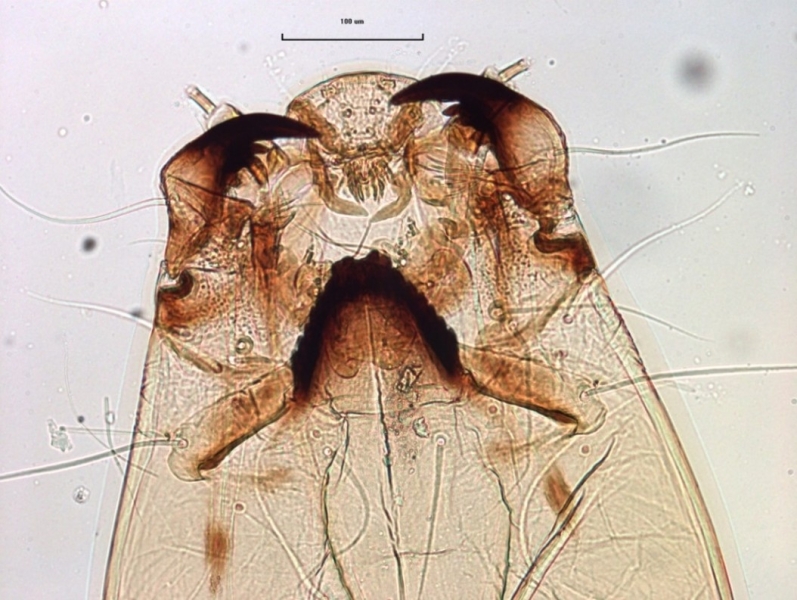
1/2
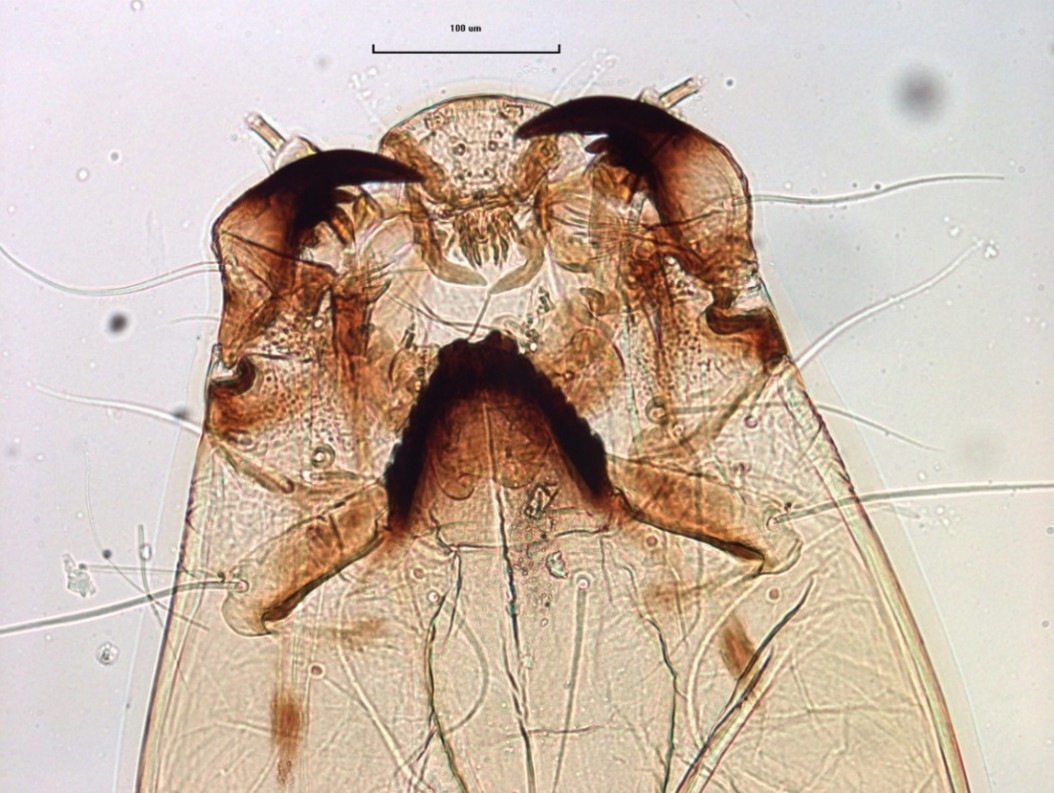
Figure 1. Monodiamesa depectinata head capsule. Dark mentum and mandibular teeth. Note the strongly arched mentum with a broad, concave median tooth, and elongated ventromental plates typical of Monodiamesa sp. This individual was found in Lake Huron during the CSMI 2022 survey.
Download Image -
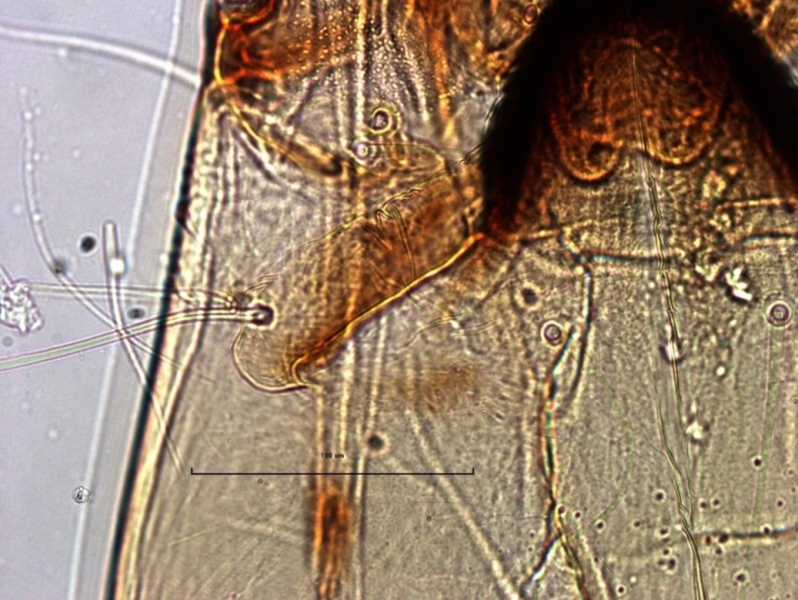
2/2
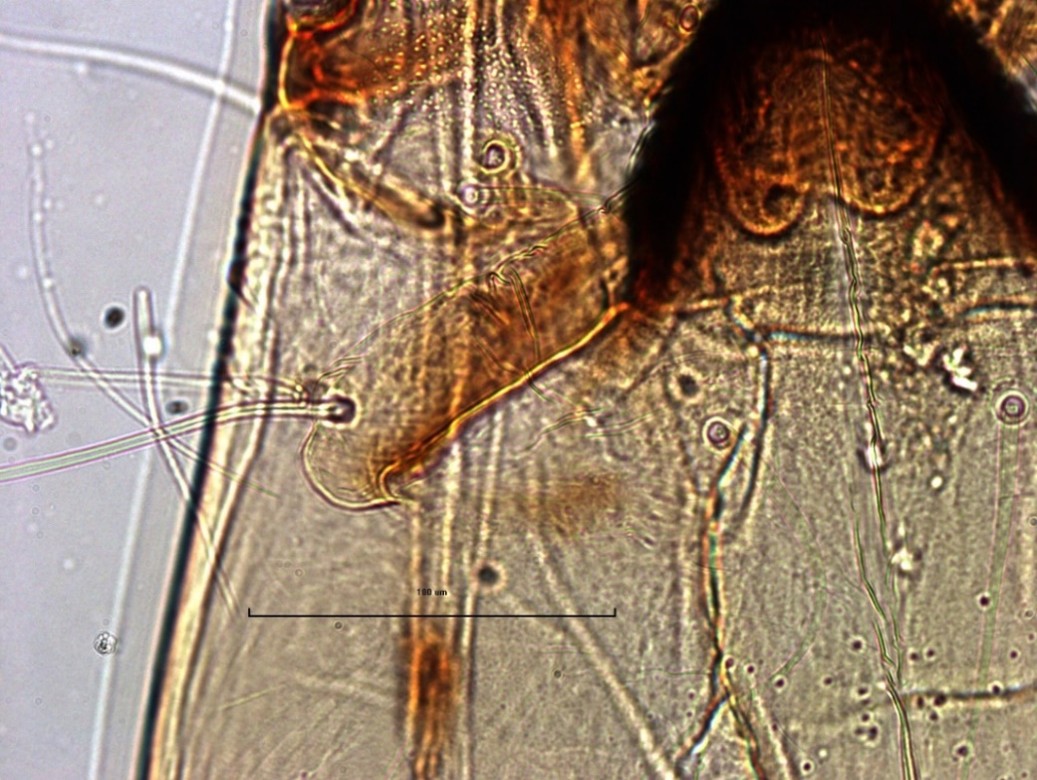
Figure 2. Monodiamesa depectinata ventromental plate. Note the broad, long plate covers the large general setae and has a concave shape at the tip. This specimen was found in Lake Huron during the CSMI 2022 survey.
Download Image
Monodiamesa depectinata
Taxa description
The large freshwater Chironomidae Monodiamesa depectinata Saether, 1973 is in the Prodiamesinae subfamily. This species has extremely long, broad, unstriated ventromental plates that extend out far enough to cover the large general setae (Fig. 2). The elongated, almost bar-like ventromental plates have a concave shape on the distal end. These wide plates, typically 29-38 µm in width, distinguish M. depectinata from other species of the genus. For comparison, M. bathyphila, the most similar-looking species in the genus, has much narrower plates that are typically 24-26 μm in width. The mentum is overall dark in color and strongly arched. The mentum has 13 teeth in total, with a broad, concave median tooth giving the look of two small points. The combination of long ventromental plates and a strongly arched mentum is unique among Chironomidae. The mandibles have a large hook-like apical tooth with two small inner teeth. Both the mentum and mandibular teeth are very dark if not black. The antennae have four segments, with segments 3 and four being very small (Fig. 1). The ring organ is located on the basal third of the basal segment, with the setal mark being at the same level as the ring organ. The antennal blade is slightly longer than the flagellum.
Distinguishing features
The combination of long ventromental plates and a strongly arched mentum is unique among Chironomidae.
Habitat
Monodiamesa larvae are found in all zones of lakes, preferring sandy substrates, and can exist in eutrophic conditions.
Lake occurrence
Monodiamesa depectinata has been previously found in lakes Superior, Huron, Michigan, and Erie (NOAA and USEPA 2019).
Similar species
These wide ventromental plates, typically 29-38 µm in width, distinguish M. depectinata from other species of the genus. For comparison, M. bathyphila, the most similar-looking species in the genus, has much narrower plates that are typically 24-26 μm in width. The combination of long ventromental plates and a strongly arched mentum is unique among Chironomidae.
Relative size
Monodiamesa depectinata is a large freshwater Chironomidae.
Does it have a barcode reference from the Great Lakes?
References
Andersen, T., Cranston, P.S., Epler, J.H., 2013. The larvae of the Chironomidae (Diptera) of the Holarctic Region. Insect Systematics & Evolution, Supplement No 66.
Bolton, M.J., 2007. Ohio EPA supplemental keys to the larval Chironomidae (Diptera) of Ohio and Ohio Chironomidae checklist. Ohio EPA.
Epler, J.H., 2001. Identification manual for the larval Chironomidae (Diptera) of North and South Carolina.
NOAA and US EPA. 2019 Great Lakes Waterlife. Accessed on 09/05/2023.
Occurrence in scientific literature
Fletcher, R., Baker, S. and Petro, S. 2007. Biomonitoring study of Thunder Bay Harbour in the vicinity of Cascades Fine Paper. Water Monitoring and Reporting Section and Environment Monitoring and Reporting Branch report, Thunder Bay.
Mozley, S.C. and R.P. Howmiller. 1977. Environmental status of the Lake Michigan region. Vol. 6, Benthos of Lake Michigan. Argonne Nat. Lab. ANL/ES-40. Argonne, Ill. 48 pp.
Nalepa, T. F., Fanslow, D. L., Lansing, M. B., Lang, G. 2002. Abundance, biomass, and species composition of benthic macroinvertebrate populations in Saginaw Bay, Lake Huron, 1987-96. Great Lakes Environmental Research Lab, Ann Arbor, MI, tech memo. GLERL-122.
Saether, O.A. 1973. Taxonomy and ecology of three species of Monodiamesa Kieffer, with keys to Nearctic and Palearctic species of the genus (Diptera: Chironomidae). J. Fish. Res. Board Can. 30:665-679.