

Ripistes parasita
-
1/9
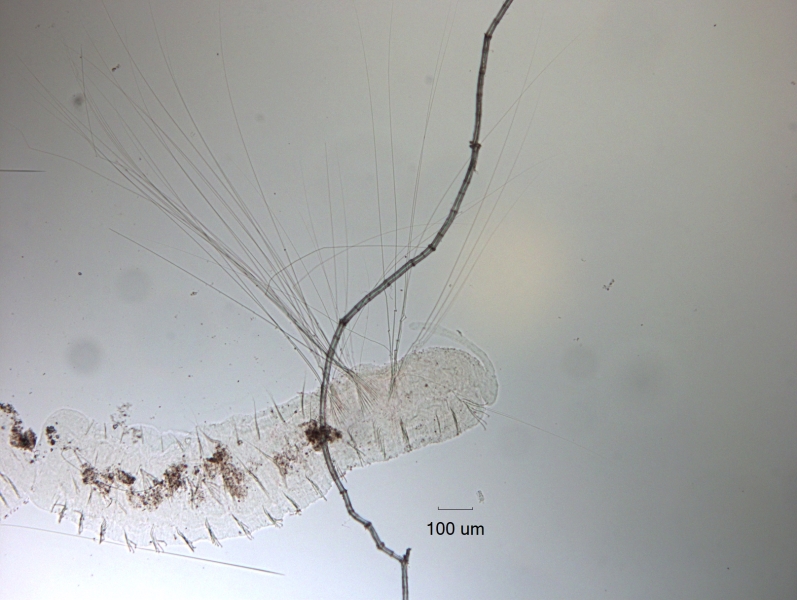
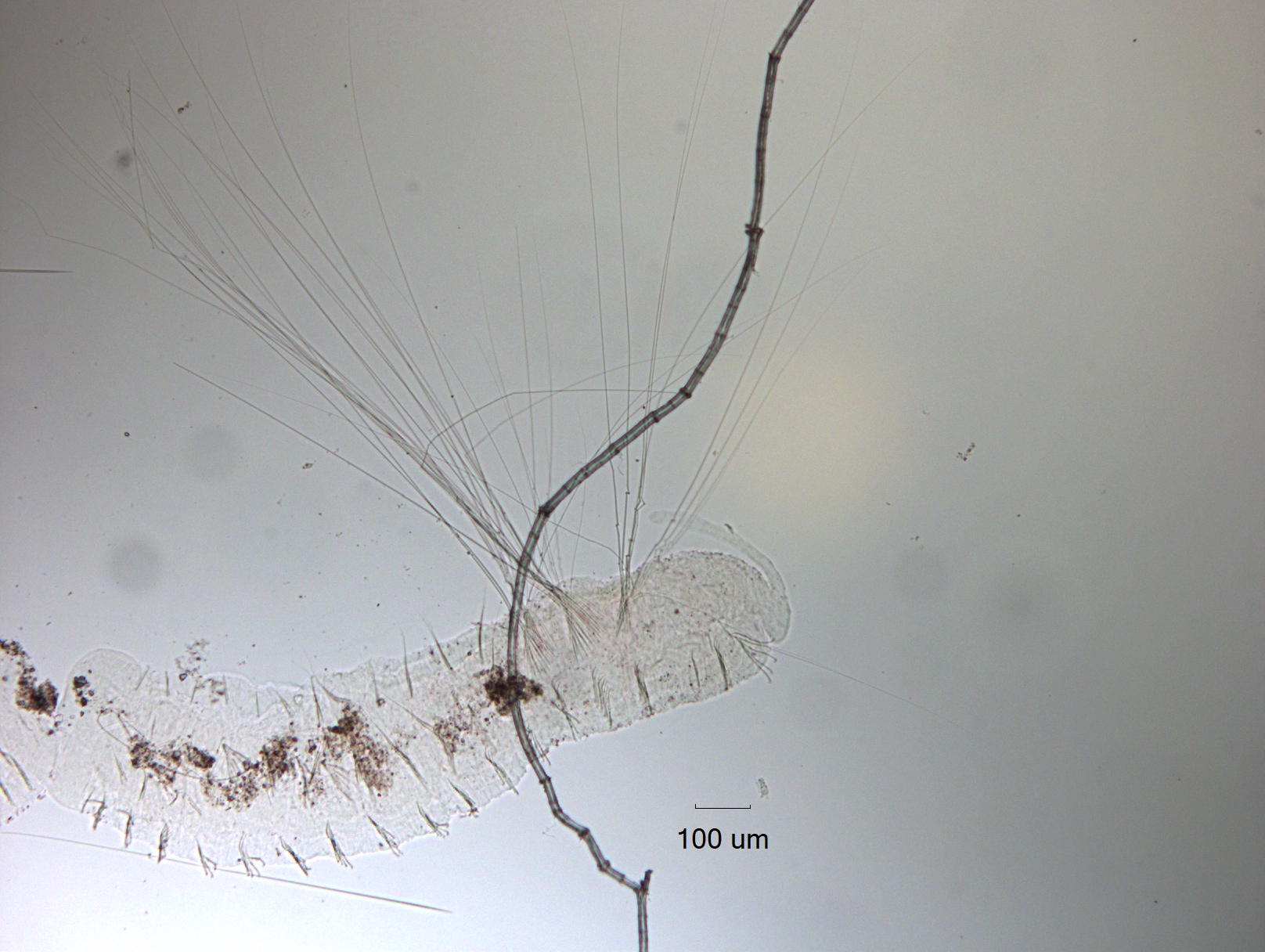
Figure 1. The giant hairs of R. parasita are conspicuously much longer than the shorter hairs of IX and beyond. There is a proboscis curved up over the head. This individual was found in Lake Huron during sampling in 2022.
Download Image -
2/9
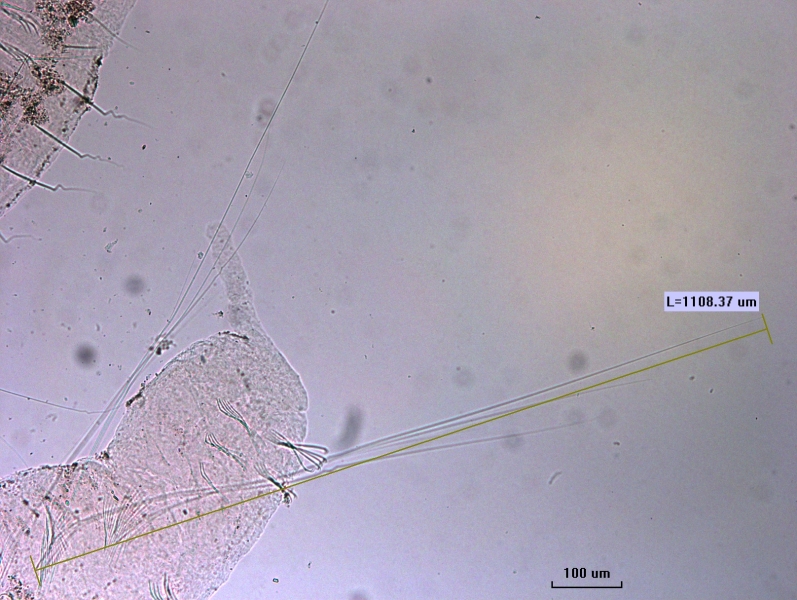
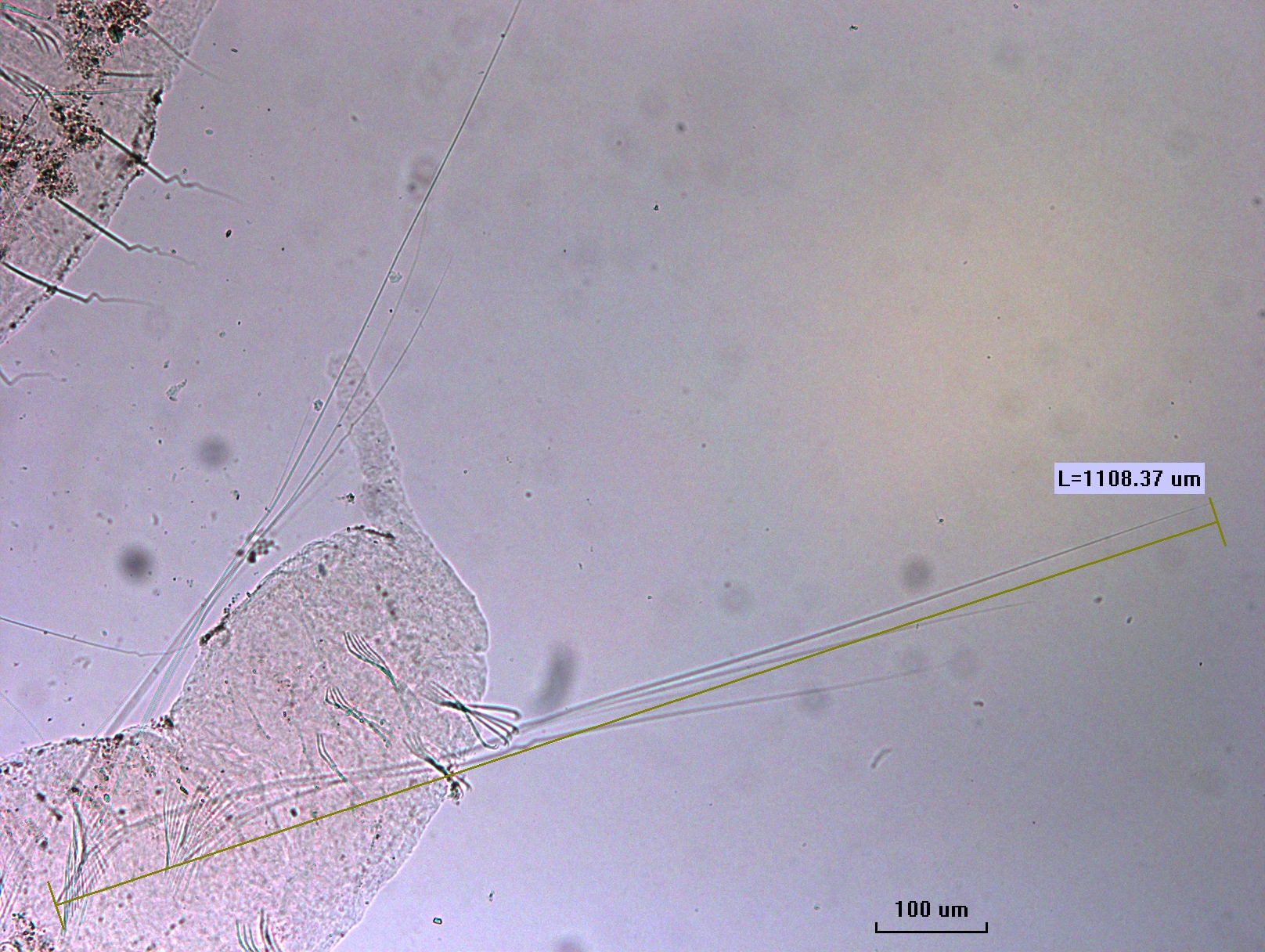
Figure 2. The giant hairs of R. parasita are around 1100µm. The proboscis is sticking straight upward. This individual was found in Lake Huron during sampling in 2022.
Download Image -
3/9
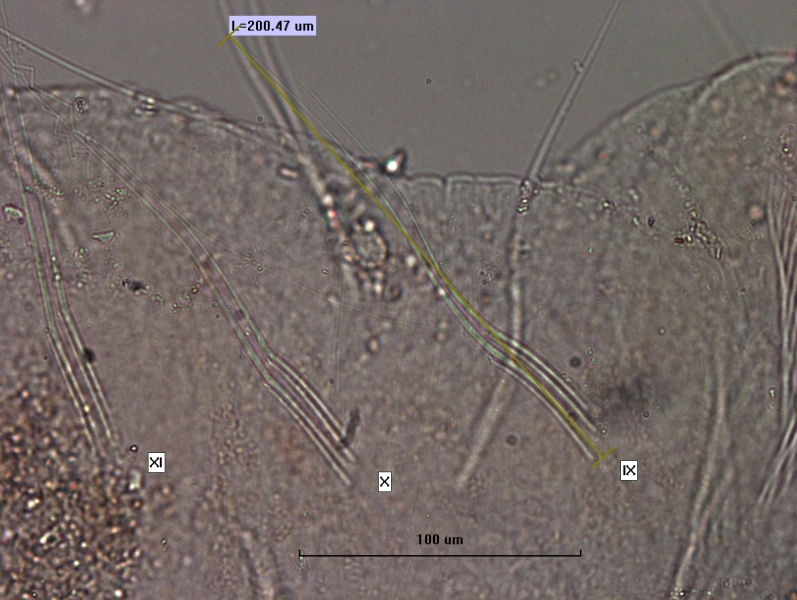
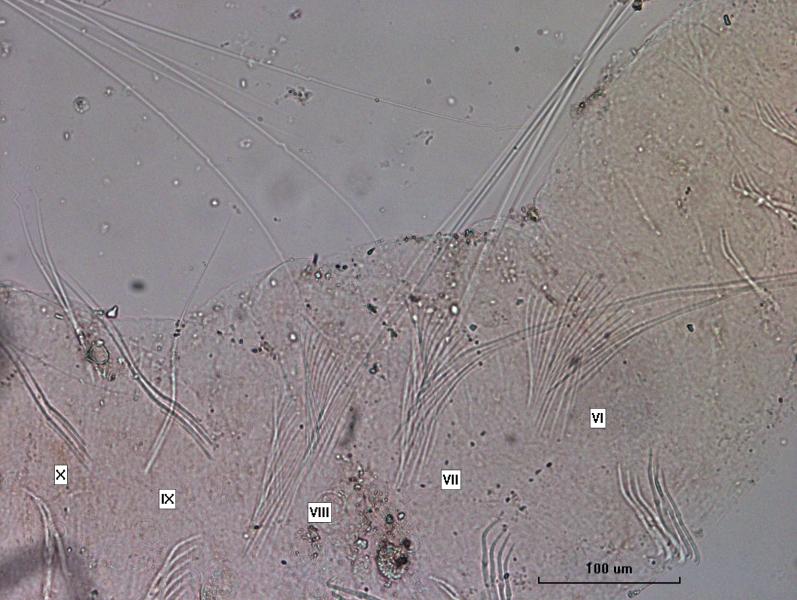
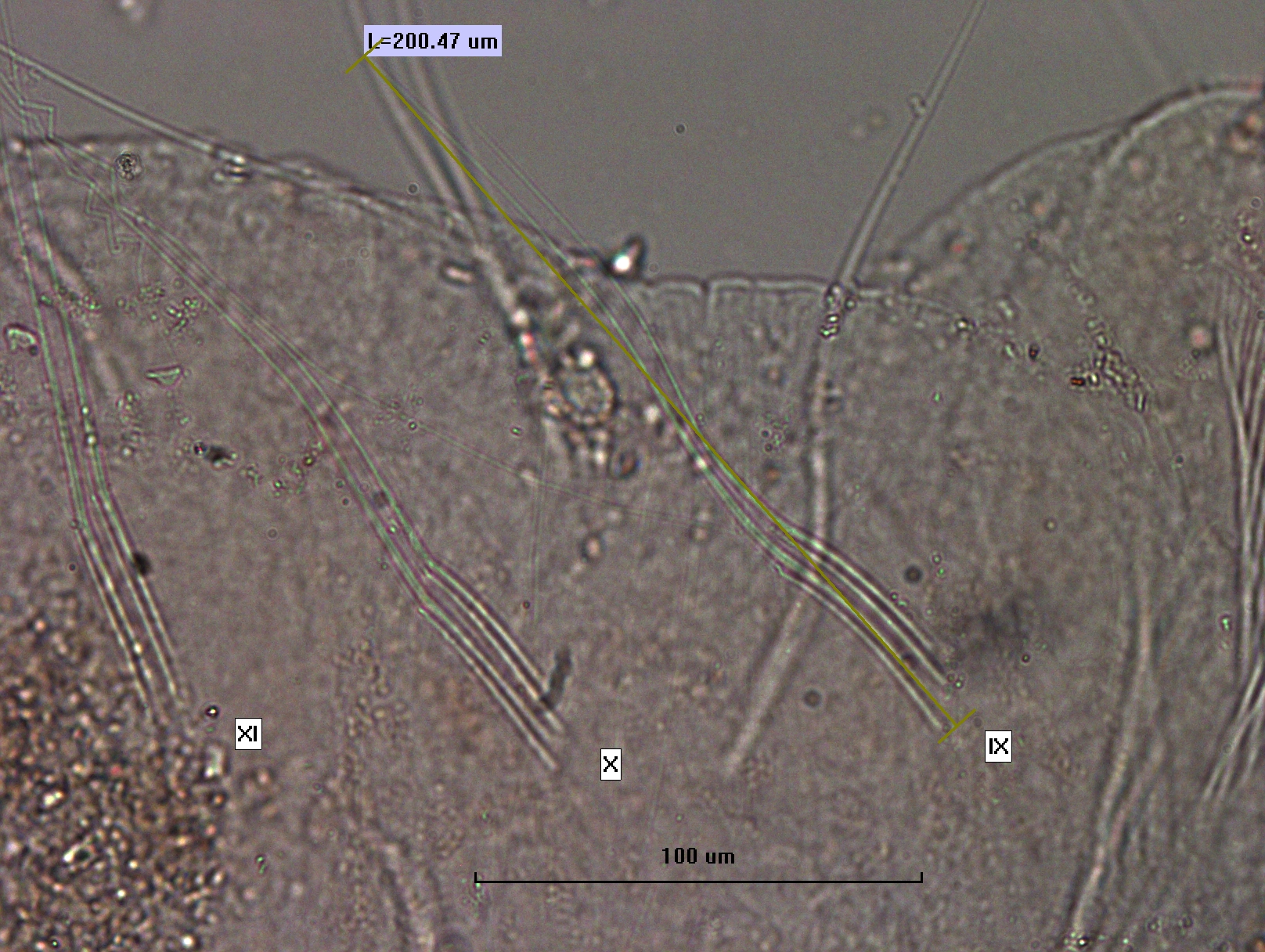
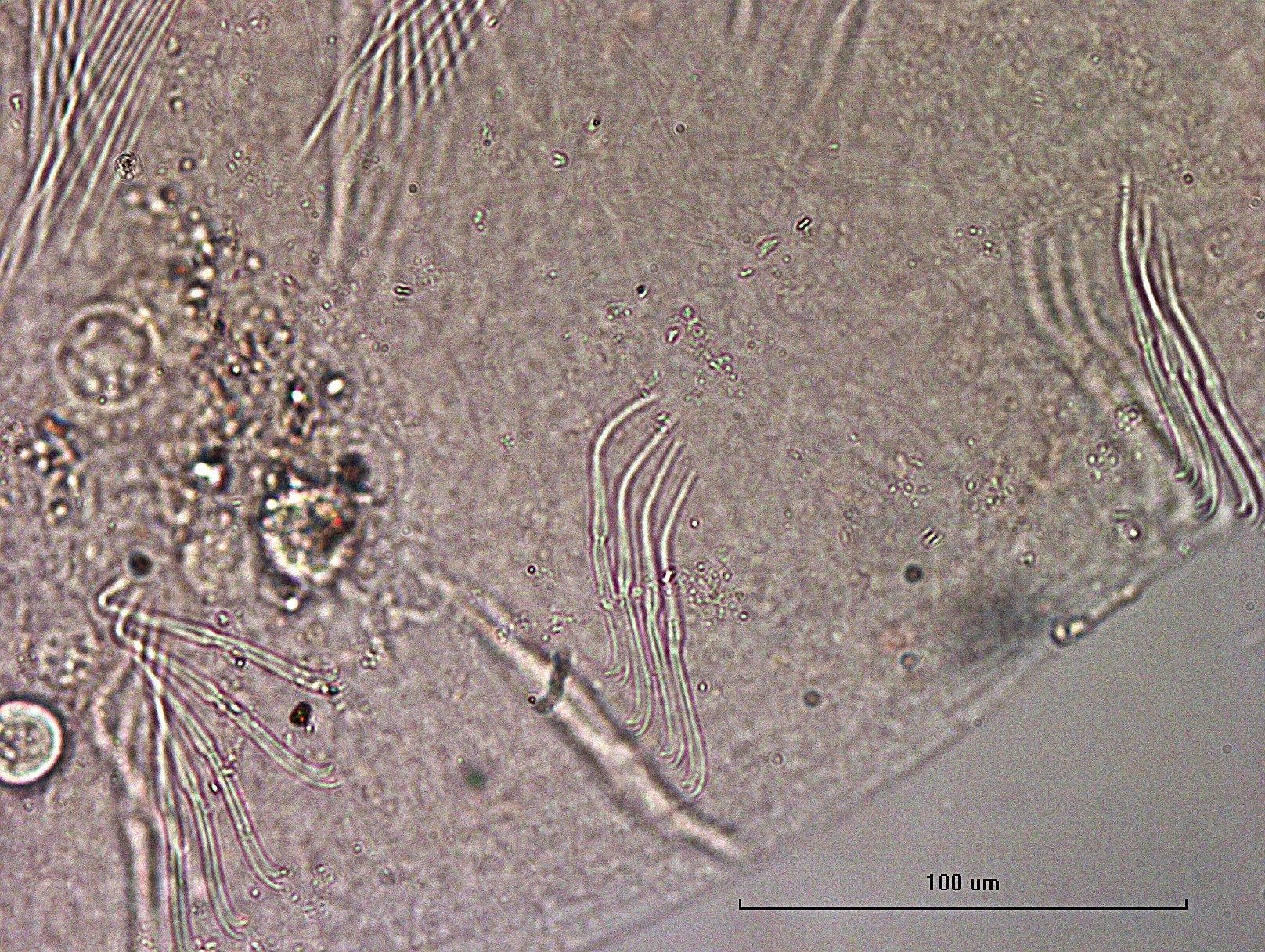
Figure 6. The short hairs of R. parasita from IX and on are around 200µm. There are only a few hairs and needles in these bundles, and the hairs are robust. They taper from thicker at the bottom to thinner by about halfway without a nodulus. Hairs don't usually change width very much.
Download Image -
4/9
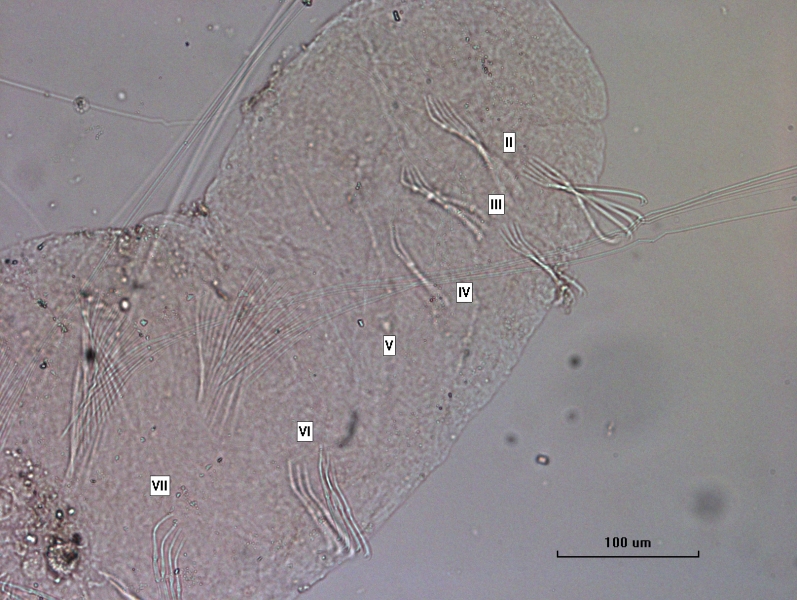
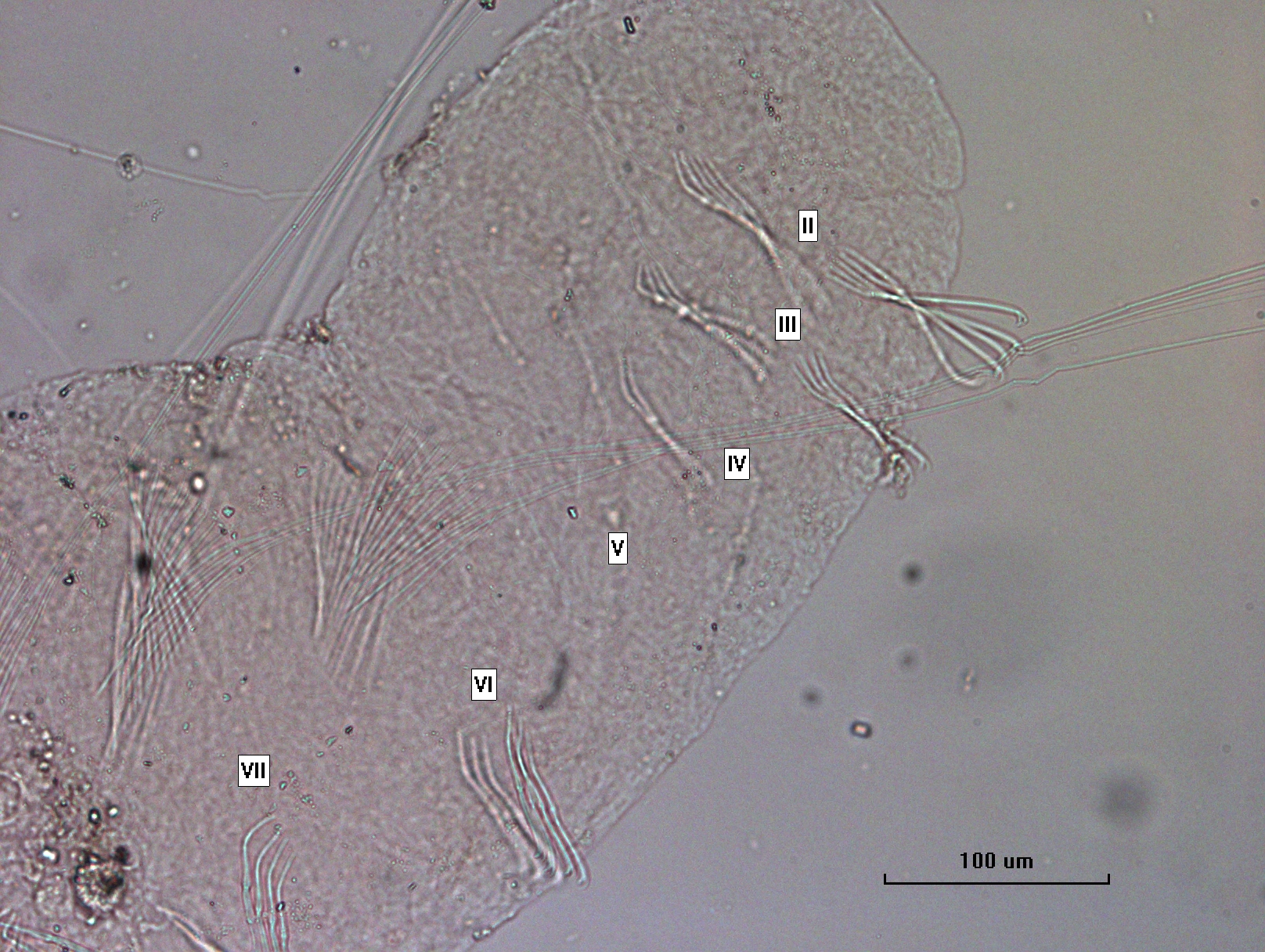
Figure 3. The anterior segments of R. parasita, showing the giant chaetae and numerous needles in VI and VII, no hair chaetae before VI, ventral chaetae with a single bend, and ventral chaetae missing in IV and V (except for two chaetae on one side in IV).
Download Image -
5/9
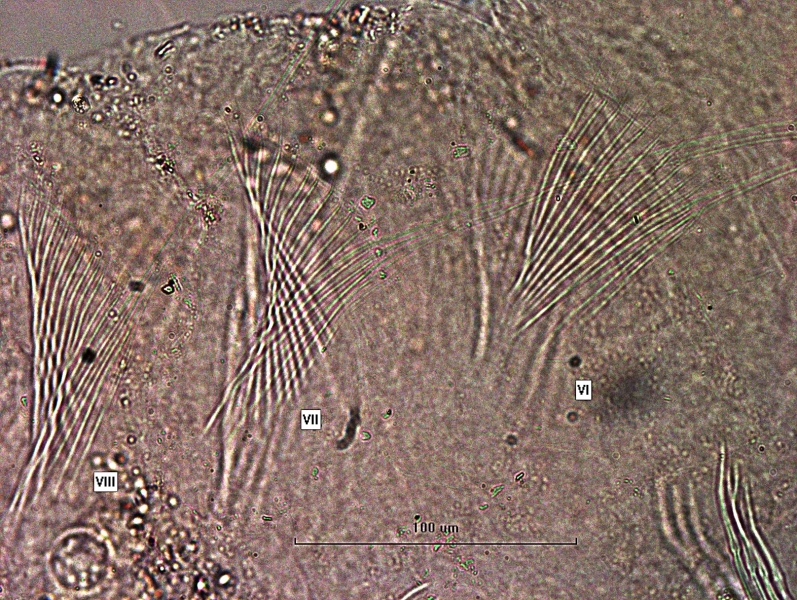
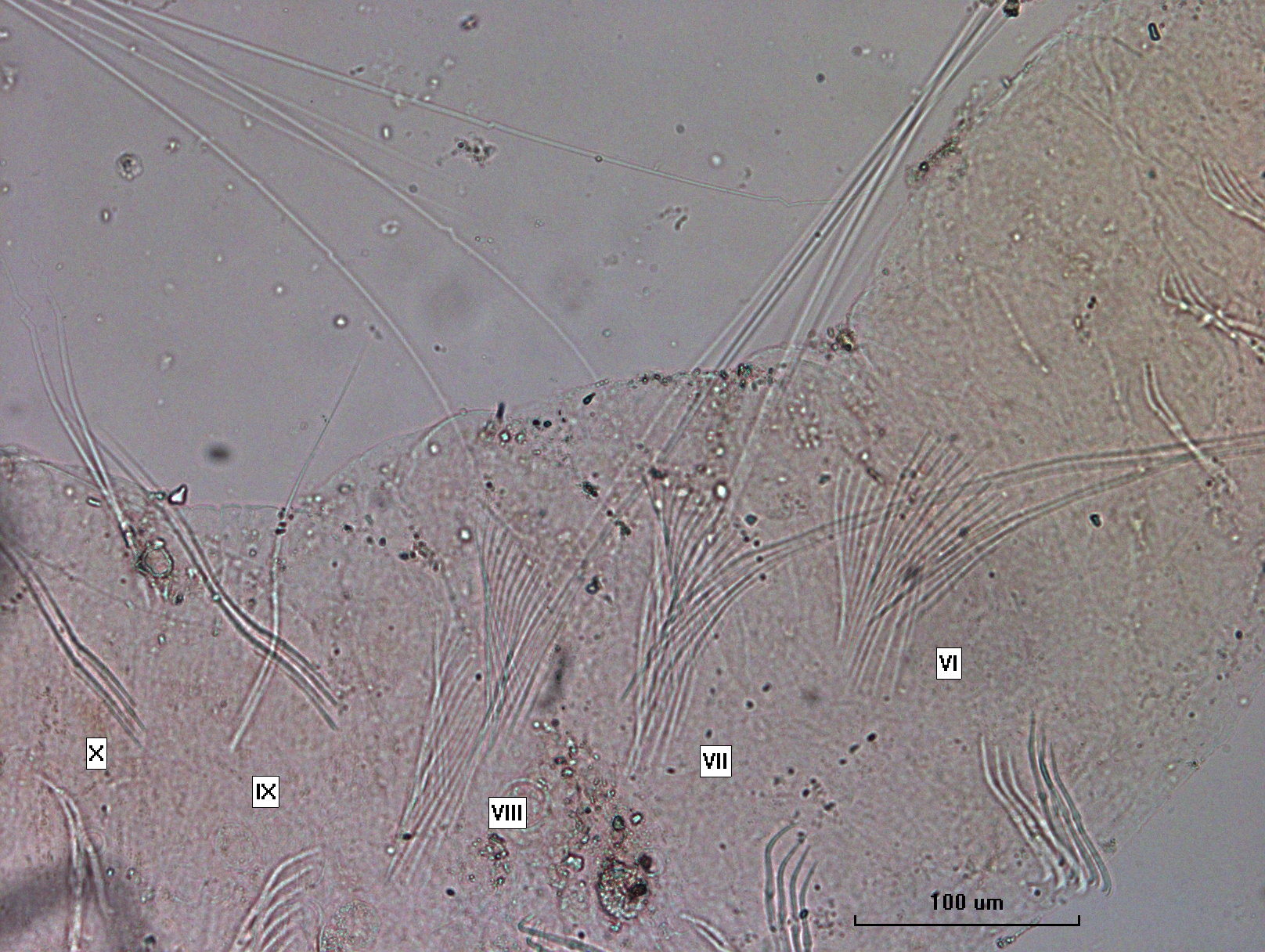
Figure 4. The dorsal chaetae of R. parasita switch between VIII and IX. There are three segments with giant hairs and many short needles in VI-VIII and segments with with few short hairs and needles in IX and beyond.
Download Image -
6/9
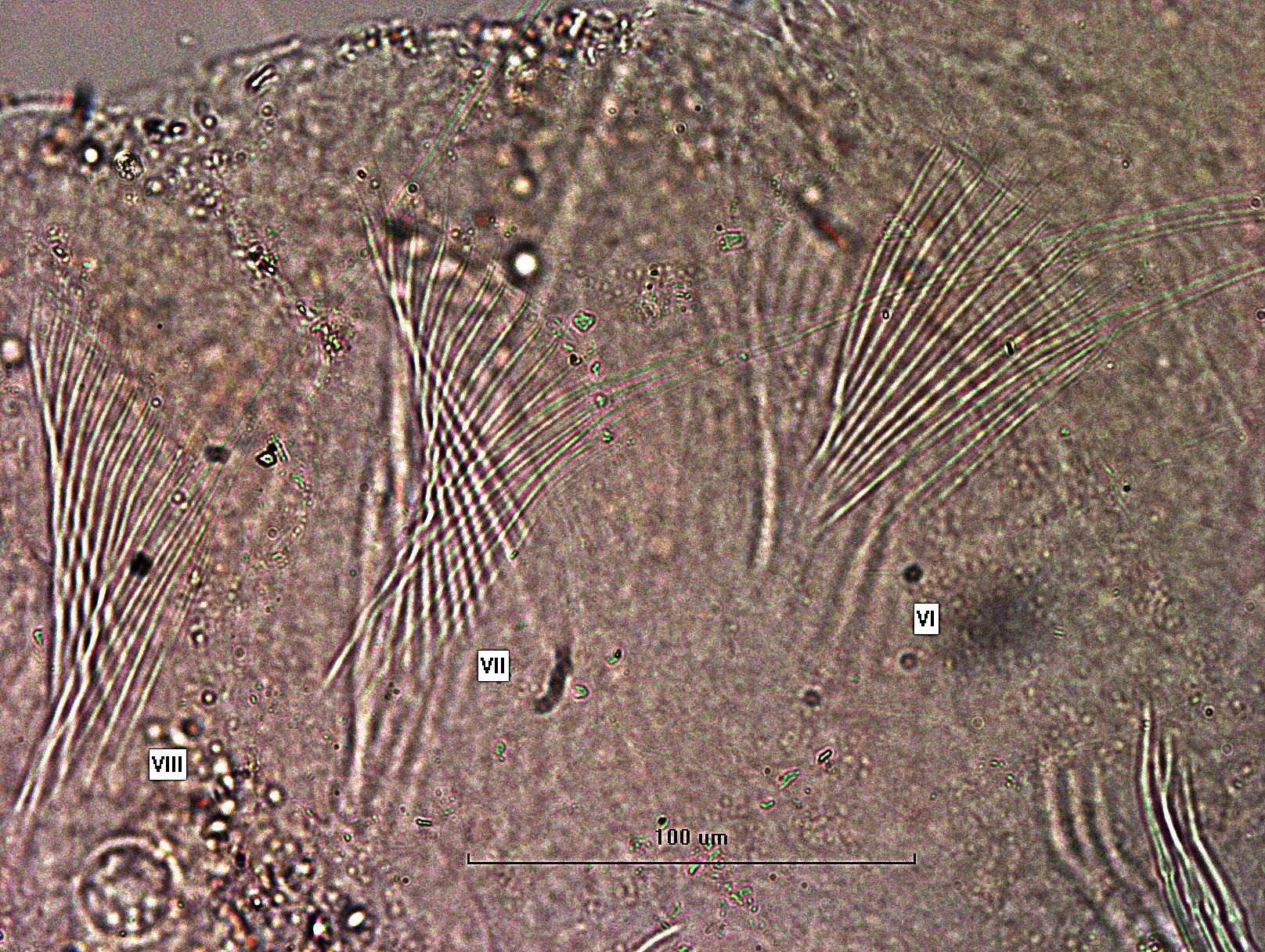
Figure 5. The dorsal chaetae in VI through VIII have giant hairs and many short simple-pointed needles with very thin tips. The hairs are thicker, but hard to see in this picture.
Download Image -
7/9
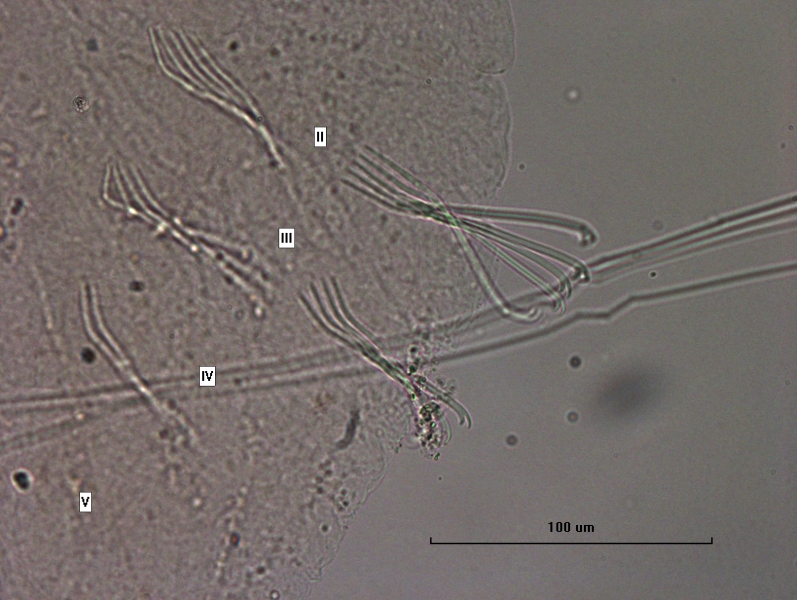
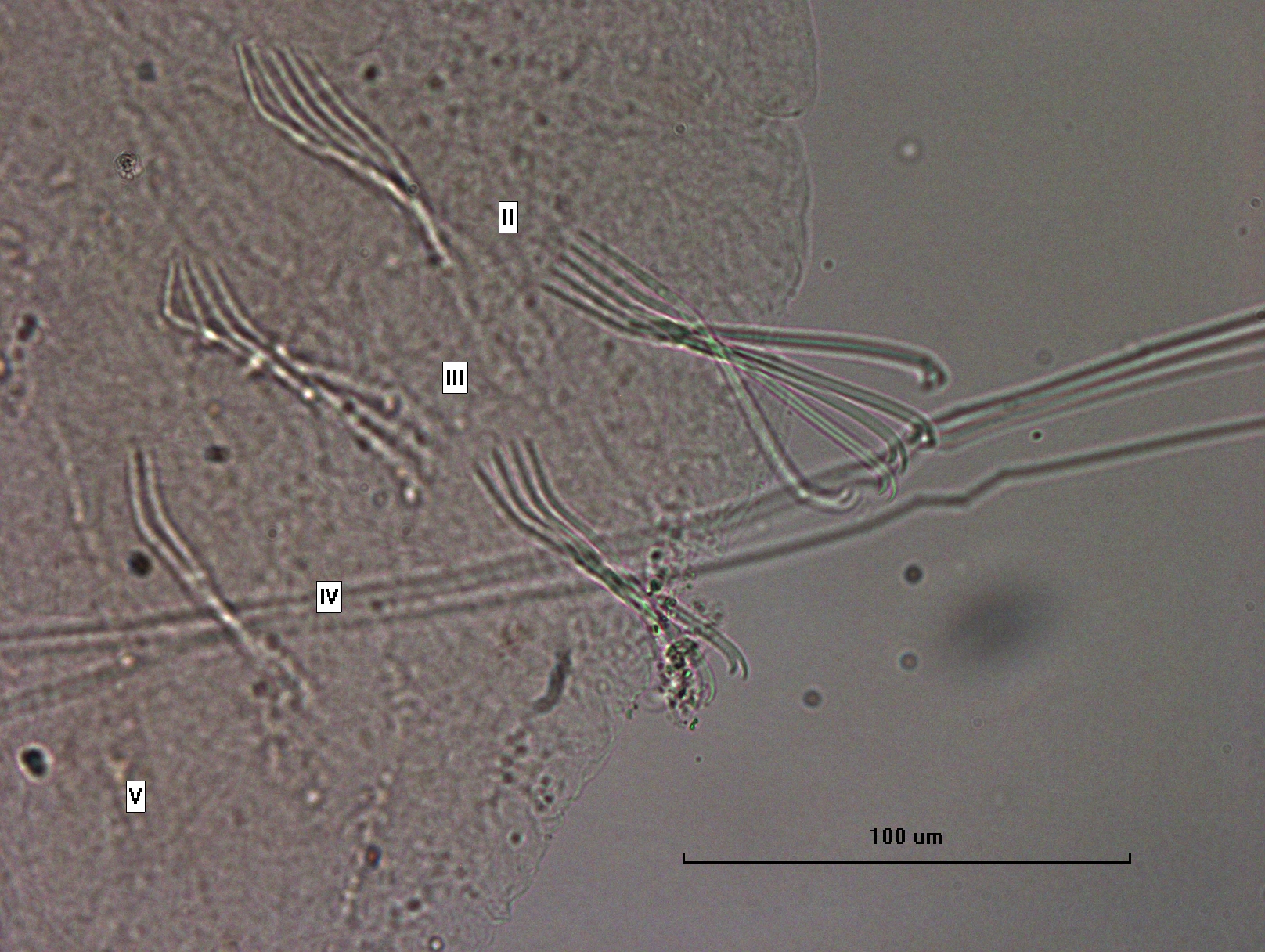
Figure 6. There are 2–7 ventral chaetae in II and III with the upper tooth longer than the lower, and II may be longer and more robust than III. The ventral chaetae of IV and V are typically absent. Here, there is a bundle in IV on only one side, and chaetae are absent on both sides in V. The nodulus is proximal (closer to the body) and there may be a slight bend in the chaetae near the nodulus.
Download Image -
8/9
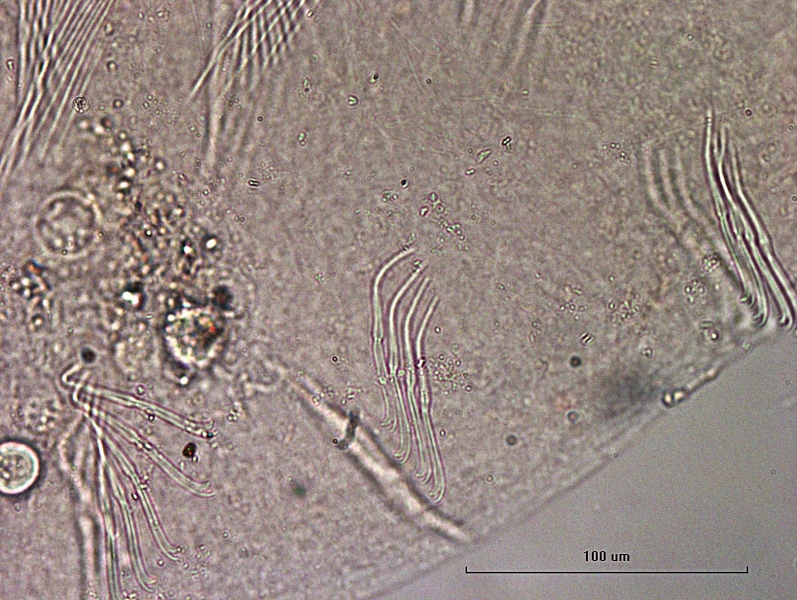
Figure 6. The ventral bundles from VI and posterior have 3–8 thicker chaetae with the upper teeth shorter than the lower, and the nodulus is more distal (closer to the end, it is almost in the middle) than the proximal nodulus of II and III.
Download Image -
9/9
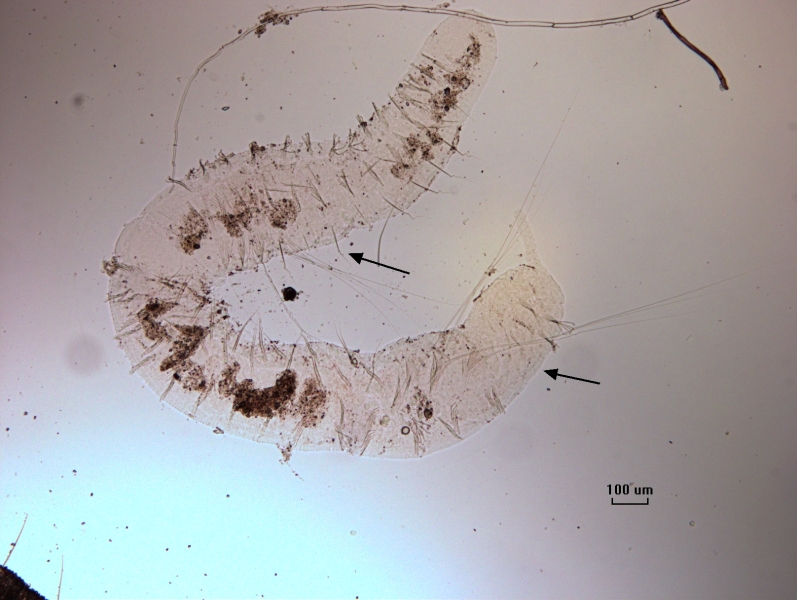
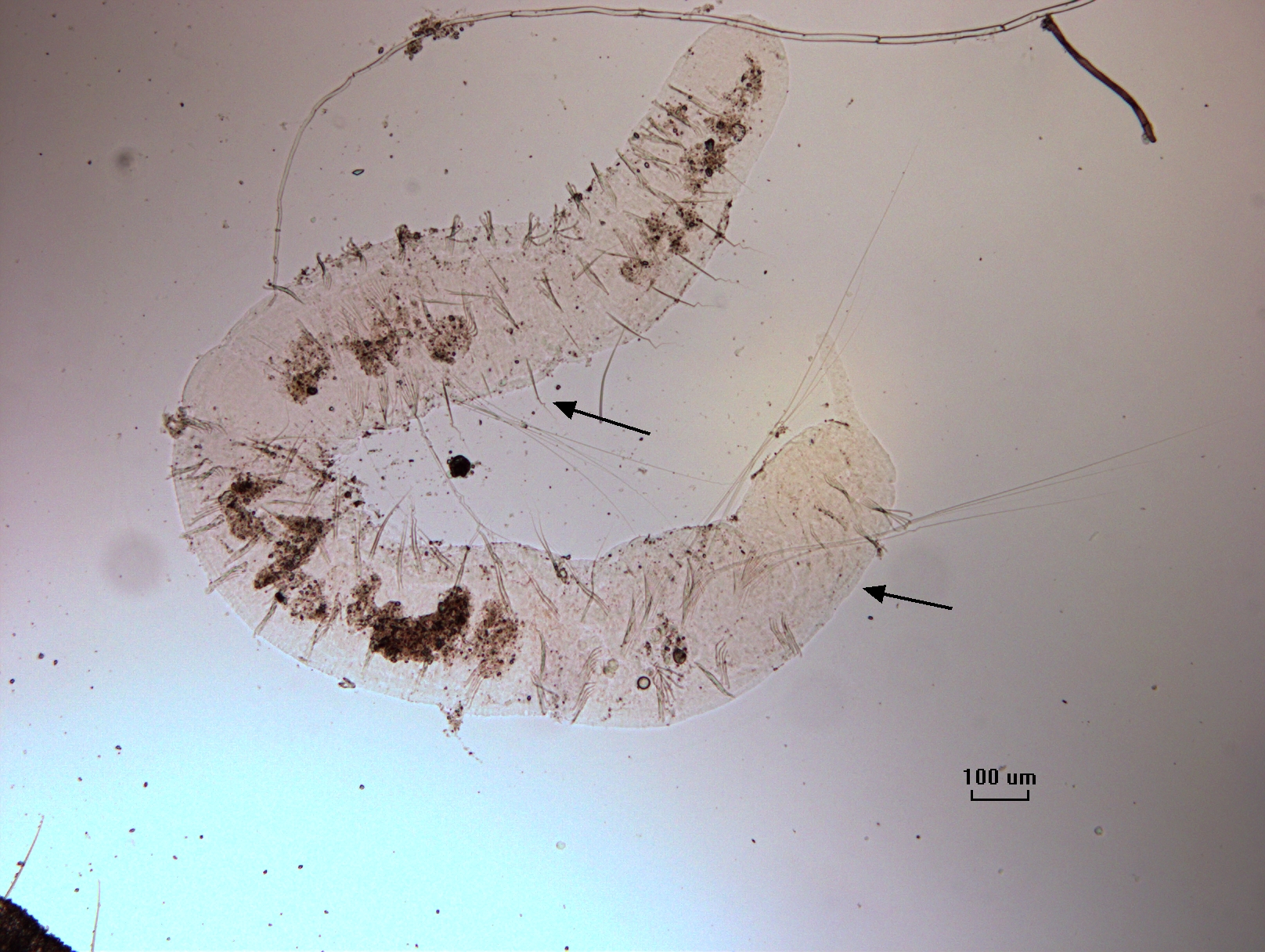
Figure 7. This specimen has a zooid developing, arrows point to two sets of extremely long hairs.
Download Image
Ripistes parasita
Taxa description
Ripistes parasita (Schmidt, 1874) is a non-native freshwater oligochaete worm from Europe and Lake Baikal that is uncommon in the Great Lakes. It is a naidid worm with dorsal bundles starting in VI and ventral bundles beginning in II, hair chaetae, and usually having a proboscis, although it may be broken. R. parasita has 2–16 giant hair chaetae in the dorsal bundles of VI–VIII, accompanied by 2–6 short hairs, and 10–18 straight simple-pointed needles without a nodulus. Posterior dorsal bundles have 1–3 shorter, more robust, and possibly hispid hairs alongside fewer needles. The giant hairs are more than three times as long as the shorter hairs in IX and on. Ventral chaetae begin in II and often have a single bend at the proximal end. There are 2–7 ventral chaetae in II and III with the upper tooth longer than the lower, and II may be longer and more robust than III. The ventral chaetae of IV and V are typically absent. The ventral bundles from VI and posterior have 3–8 thicker chaetae with the upper teeth shorter than the lower, and the nodulus is more distal than the proximal nodulus of II and III. It may or may not have eyes.
Distinguishing features
R. parasita is identified by the giant dorsal hairs in VI–VIII with numerous simple-pointed needles, absent ventrals in IV and V, and a proboscis. Sometimes the giant hairs are missing, but there are still more needles in VI–VIII than posteriorly. If this occurs, the missing ventral chaetae can help with identification. There are sometimes a few ventral chaetae in IV, but none in V. This species usually has a proboscis but in practice the proboscis may be torn off or obscured when mounted. In that case, rely on the chaetae.
Habitat
Lake occurrence
This species has been found in the Great Lakes (Superior, Huron, and Michigan) according to the USGS Nonindigenous Aquatic Species database and in the North Channel of Lake Huron in 2001 and 2022. Minnesota, New York, Wisconsin.
Similar species
The features of R. parasita are very distinctive, but there are a few other oligochaetes that could look similar. Arcteonais lomondi, Stylaria lacustris, and S. fossularis all have a proboscis and bundles with hair chaetae starting in VI. A. lomondi has numerous dorsal hairs that often form a tent structure, all crossing at point near the proximal end, but no giant or hispid hairs. R. parasita does not have a tent-shaped cross at the proximal end of the dorsal bundles. A. lomondi’s ventral chaetae are sigmoid with the upper teeth longer and slightly thinner than the lower, while R. parasita’s ventral chaetae have a bend at the proximal end. S. lacustris has a long proboscis starting from between invaginated lobes; S. fossularis has a long proboscis starting from the end of the conical prostomium. The hair chaetae are less numerous in S. lacustris and S. fossularis and they may form a tent shape. The ventral chaetae of S. lacustris have a double-bend at the proximal end, and all are the same length. S. fossularis may only have one bend at the proximal end. None of these species have giant hair chaetae and are not missing ventral chaetae in IV and V.
A few other naidid species have elongated hair chaetae. Slavina appendiculata has dorsal bundles starting in VI with 1–3 elongated hairs in only VI, 1–2 short hairs in the rest, and 1–2 straight needles with hair-like tips. The elongated hairs are only about twice as long as the rest of the hairs, there is no proboscis, and the body wall is papillate with foreign matter attached. Unlike R. parasita, Bratislavia bilongata has dorsal chaetae starting in III with elongated hairs in III only and shorter hairs in the rest. There are only 2 smooth hairs and 2 needles per bundle and no proboscis. A few species of Pristina also have elongated hairs in II or III: P. leidyi, P. longiseta, and P. longisoma. All three have dorsal bundles starting in II, although only up to 4 hairs and needles, which is fewer than R. parasita. P. leidyi and P. longiseta have a proboscis, while P. longisoma does not. Of all these species, S. appendiculata would be the most likely to be confused due to elongated hairs since the chaetal bundles start in VI, not II or III, and the fact that it is commonly found in our Great Lakes samples. P. longiseta has been found in our Great Lakes samples. P. leidyi is not in our samples but is widespread. B. bilongata has only been found in Florida and New Jersey. P. longisoma is only in Arkansas, Florida, and Louisiana. However, none of these species have numerous hairs and needles associated with their elongated chaetae. Most lack a proboscis, and all have ventral chaetae in IV and V.
Lastly, if the proboscis is missing, it will not key out properly. The only other oligochaete with numerous hair chaetae starting in VI is Vejdovskyella. V. intermedia is more likely than V. comata in our samples. V. intermedia lacks eyes and a proboscis, has 4–9 long hispid, bifid hair chaetae and 4–9 simple needles with broad tips, has anterior ventral chaetae decreasing in size to V, single ventral chaetae starting in VI and beyond, VI–VIII may have giant chaetae with thin replicated upper teeth, and there may be foreign matter attached. V. comata has 4–8 hispid hairs and 1–8 simple needles with broad tips that may appear to start in V because there are no ventrals in V, usually has eyes but no proboscis, has anterior ventral chaetae decreasing in size to IV with V and maybe IV absent, 2–3 ventrals starting in VI, occasionally a single giant chaetae with a single thin upper tooth in VI–VIII, and scattered papillae on the body wall. Vejdovskyella spp. are usually very small compared to other naidids, so even though their numerous hairs are long, they still might only be 300µm compared to a 1000µm giant hair from R. parasita. Vejdovskyella spp. also have numerous hairs in each bundle, not just VI–VIII. Despite confusion from the key, it would not be easy to mistake R. parasita for Vejdovskyella.
Relative size
R. parasita is a small freshwater oligochaete.
Does it have a barcode reference from the Great Lakes?
No, this species does not yet have a barcode reference from the Great Lakes.
References
Kathman, R.D., and R.O. Brinkhurst. 1998. Guide to Freshwater Oligochaetes of North America. p. 62–63, 34, 38, 56–61, 78–79, 92–95.
Hiltunen, J.K., and D.J. Klemm. 1980. A Guide to the Naididae (Annelida: Clitellata: Oligochaeta) of North America. pp. 19, 38.
Simpson, K.W., and L.E. Abele. 1984. Ripistes parasita (Schmidt) (Oligochaeta: Naididae), a distinctive oligochaete new to North America. Freshwat. Invert. Biol. 3: 36-41.
USGS Nonindigenous Aquatic Species database entry for Ripistes parasita.
Occurrence in scientific literature
Spencer, D.R., Hudson, P.L. 2003. The Oligochaeta (Annelida, Clitellata) of the St. Lawrence Great Lakes region: an update. J. Great Lakes Res. 29, 89-104.