

Phylocentropus sp.
-
1/2
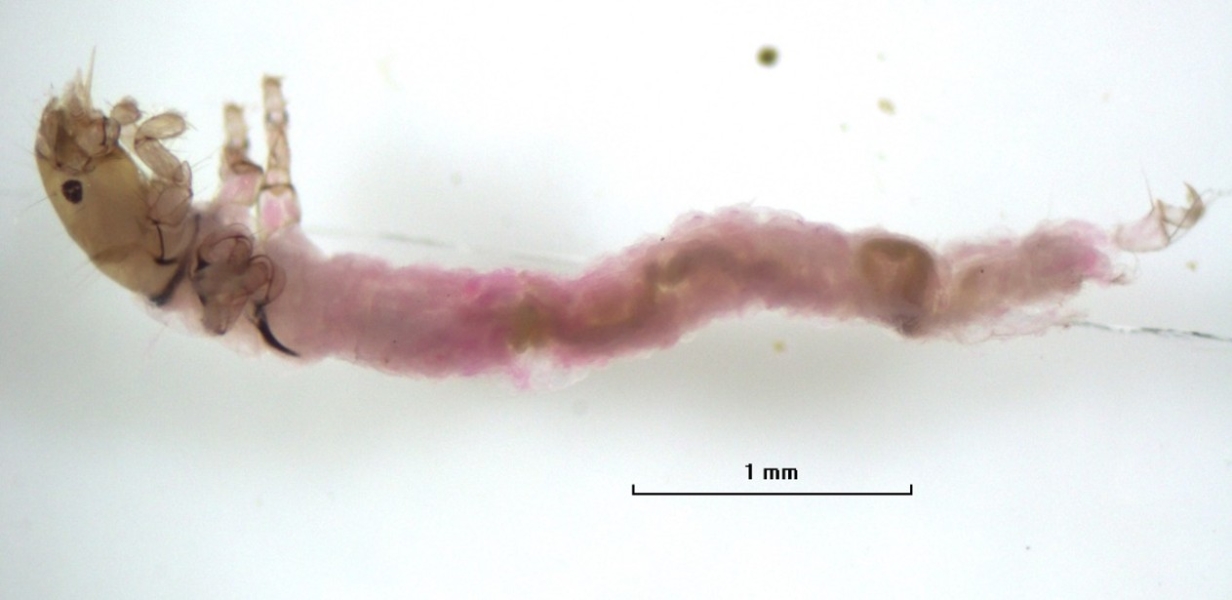
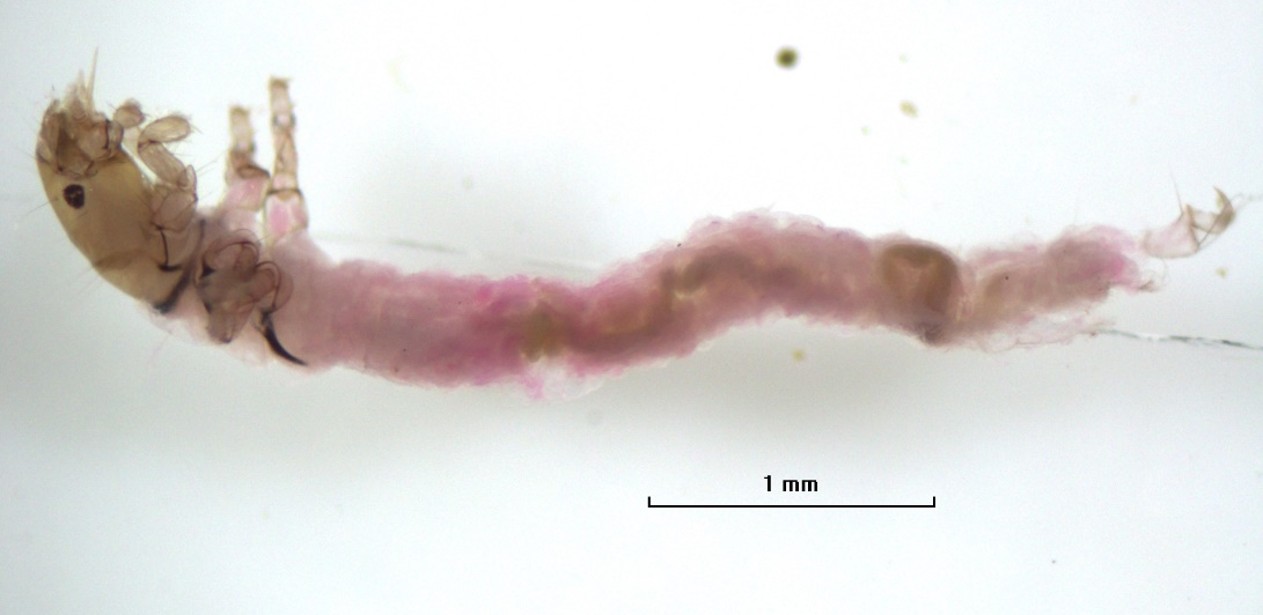
Figure 1. Whole body of Phylocentropus spp. collected during the CSMI Lake Erie survey in 2024. Note the weakly sclerotized plates, long body, and short legs.
Download Image -
2/2
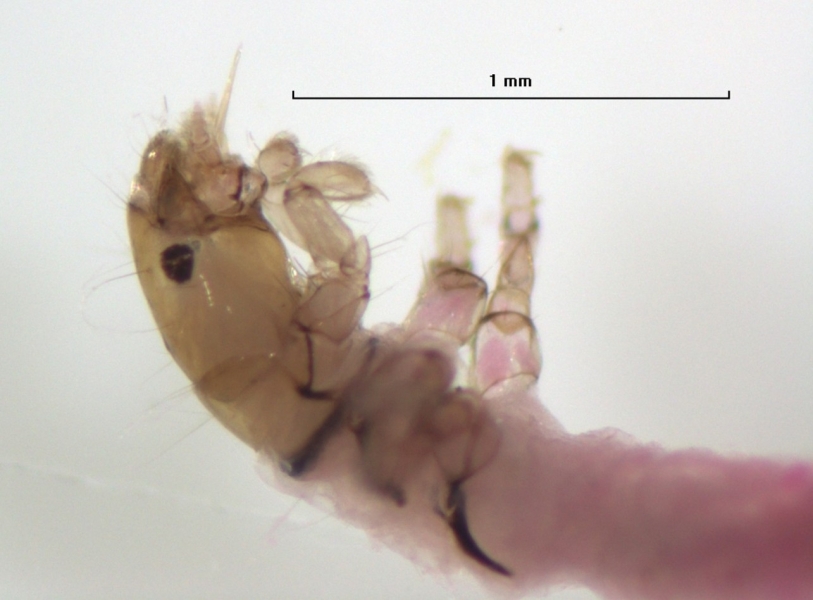
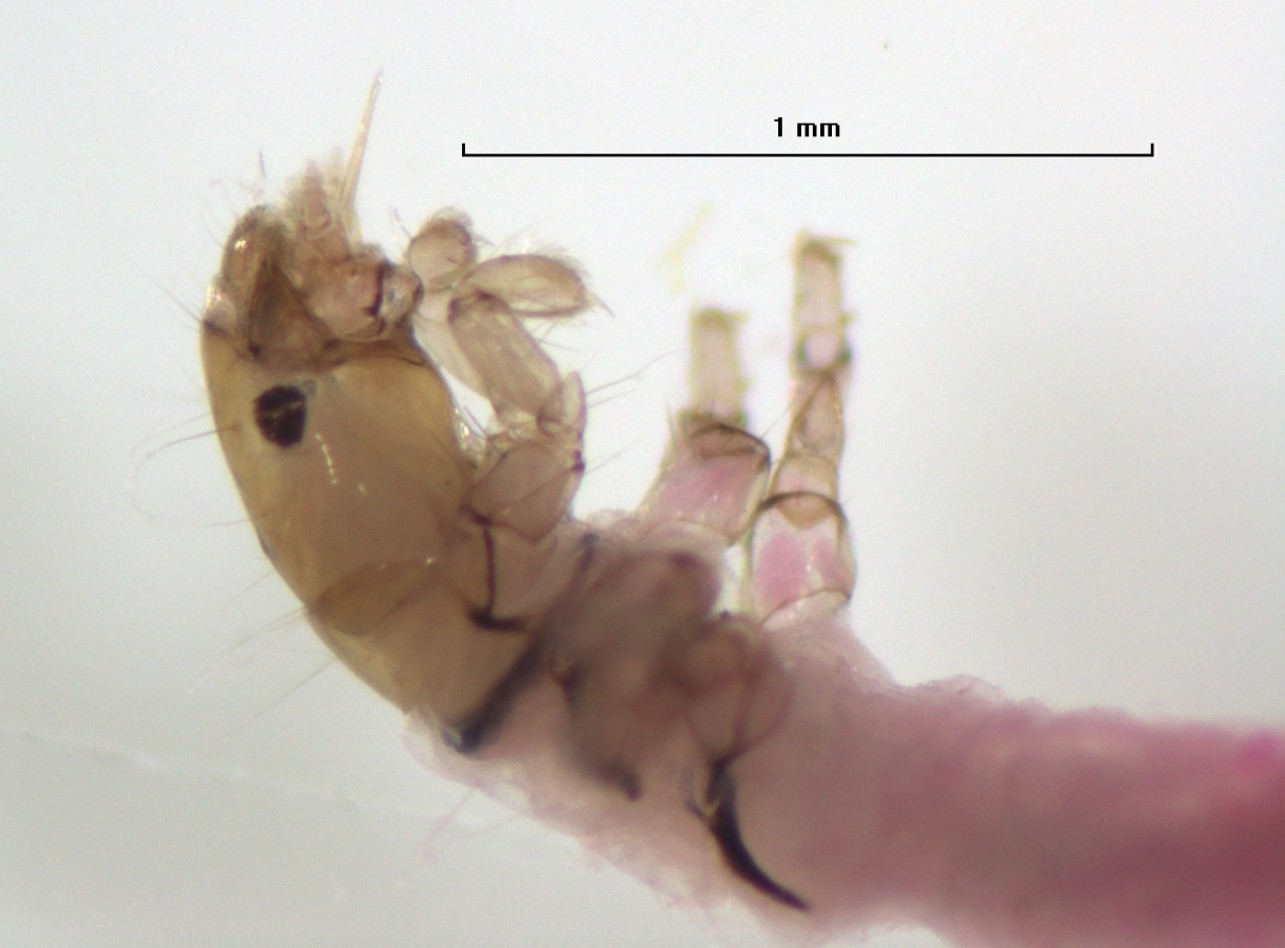
Figure 2. Closeup of head and legs of Phylocentropus spp. Note the long labium and broad and flat tarsi of all legs.
Download Image
Phylocentropus sp.
Taxa description
Phylocentropus sp. Banks, 1907 is one of six genera of Trichoptera within the family Polycentropodidae and is easily distinguishable by its broad and flat tarsi of all legs, and the tip of the labium is very long, likely to aid in applying silk to the dwelling tubes (Figures 1, 2). Body of mature larva is 15-19 mm long with the larval head brown, covered dorsally by many small, white spots ("muscle scars"), frontoclypeus not evidently darkened posteriorly (Sturkie and Morse 1998). The retreat consists of branching tubes of silk covered with sand and small pieces of detritus in sedimentary deposits along margins of sandy streams and lakes.
Distinguishing features
Habitat
Lake occurrence
Our specimens are likely P. placidus, which were recorded from lakes Superior, Michigan, Huron, and the Huron Erie Corridor (NOAA and US EPA 2019).
Similar species
Relative size
Body of mature larva is 15-19 mm.
Does it have a barcode reference from the Great Lakes?
References
Merritt, R.W., and Cummins, K.W. eds., 2008. An introduction to the aquatic insects of North America. Kendall Hunt.
NOAA and USEPA. 2019 Great Lakes Waterlife. Accessed on 05/16/2025.
Sturkie, S.K. and Morse, J.C., 1998. Larvae of the three common North American species of Phylocentropus (Trichoptera: Dipseudopsidae).
Wiggins, G.B., 1996. Larvae of the North American caddisfly genera (Trichoptera). University of Toronto Press.
Occurrence in scientific literature
Cooper, M.J., Uzarski, D. 2016. Invertebrates in Great Lakes marshes. In Batzer D., Bolx, D. (Eds.), Invertebrates in freshwater wetlands an internation perspective on their ecology, Springer, New York, pp. 287-320.
US EPA. 2017. Great Lakes Invertebrate Reference Collection, 2012-present [Excel spreadsheet].Curated by contract taxonomists G.T. Shepard, A. Frankiewicz, B. Gilbertson, and E. Timmerman with specimen verification by outside experts K. Schmude, G. Mackie, T. Lee, and R. Dillon. Duluth, MN: Environmental Protection Agency, Office of Research and Development, National Health and Environmental Effects Research Laboratory, Mid-Continent Ecology Division.