

Mystacides sp.
-
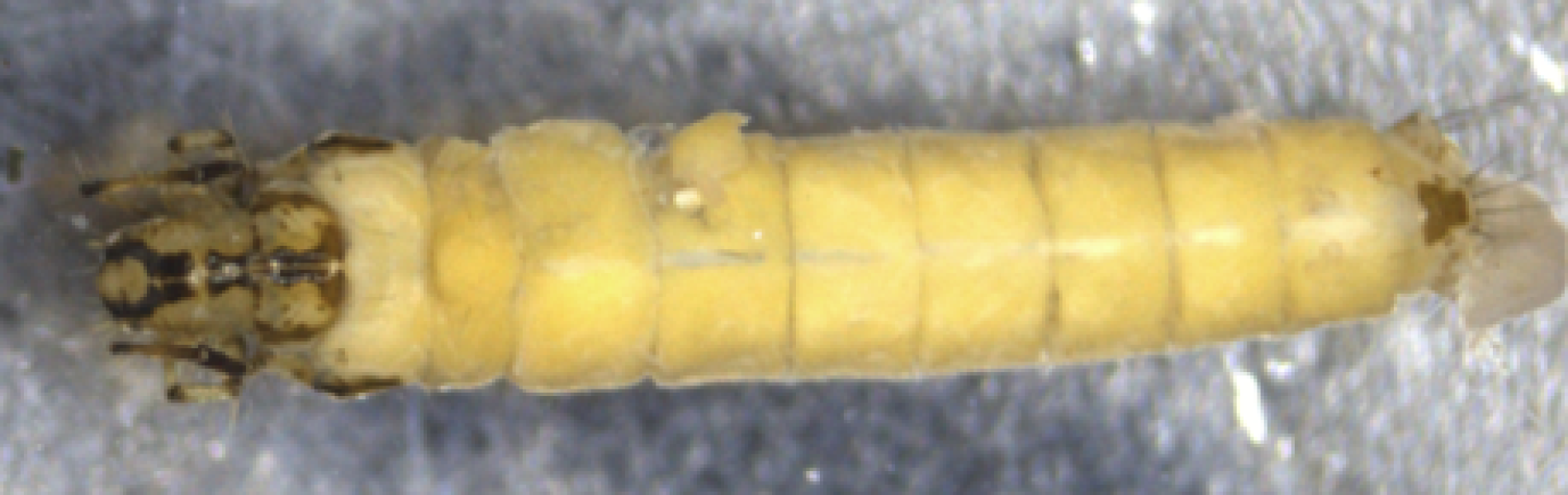
1/2
Figure 1. Whole body of Mystacides sp. Note the dark markings on the head and thoracic segment. This individual was found in Saginaw Bay, near Lake Huron in July 2022.
Download Image -
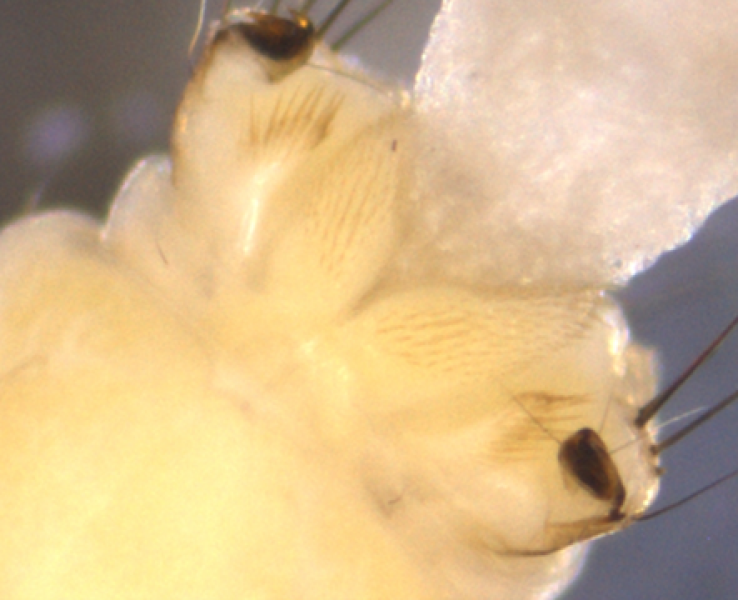
2/2
Figure 2. Anal proleg of Mystacides sp., note the row of spines that distinguish from others. This individual was found in Saginaw Bay, near Lake Huron in July 2022. The spines are fainter than the dark brown setae, they are 5-7 light brown spines just below the prolegs.
Download Image
Mystacides sp.
Taxa description
Mystacides sp. Berthold, 1827 larvae are readily recognized by their head and thoracic markings of strongly contrasting black spots or blotches on a light background (Fig. 1). Mystacides larvae have a secondary division in both tibia and tarsus of the hind leg. Mandibles are short, the toothed points grouped around a central concavity. Single abdominal gill filaments are present in one species. Two patches of spines occur on the venter of the anal proleg in a row (Fig. 2). Mystacides sp. also have bulbous projections on the first abdominal segment which are joined on the outside by a curved spinous bar which is joined to a sclerotized bar pointing obliquely forwards (Fig. 1; Hickin 1967). Cases are irregular and are comprised of plant and mineral materials with twigs or conifer needles extending past the ends (Merritt et al. 2008).
Distinguishing features
Habitat
Larvae are usually found in the shallows along shores of lakes and ponds, or in areas of slow current of rivers (Wiggins 1996).
Lake occurrence
Mystacides sp. has records from Lakes Superior, Huron, Erie, and Ontario, as well as connecting channels in the region (NOAA and US EPA, 2019).
Similar species
Relative size
Does it have a barcode reference from the Great Lakes?
References
Merritt, R.W., and Cummins, K.W. eds. 2008. An introduction to the aquatic insects of North America. Kendall Hunt.
Hickin, N.E. 1967. Caddis larvae: larvae of the British Trichoptera. Fairleigh Dickinson University Press.
NOAA and USEPA. 2019 Great Lakes Waterlife. Accessed on 09/05/2023.
Wiggins, G.B. 1996. Larvae of the North American caddisfly genera (Trichoptera). University of Toronto Press.
Occurrence in scientific literature
Burton, T.M., Uzarski, D.G., Genet, J.A. 2004. Invertebrate habitat use in relation to fetch and plant zonation in northern Lake Huron coastal wetlands. Aquatic Ecosys. Health Manage., 7, 249-267.
Davis, B. M., Hudson, P. L., Armitage, B. J. 1991. Distribution and abundance of caddisflies (Trichoptera) in the St. Clair-Detroit River system. J. Great Lakes Res., 17(4), 522-535.
Dermott, R., Pachkevitch, A. 2012. Biotic indices of the littoral benthic community from the Bay of Quinte, eastern Lake Ontario. Can. Manuscr. Rep. Fish. Aquat. Sci., 2996.
DeWalt, R. E., South, E. J. 2015. Ephemeroptera, Plecoptera, and Trichoptera on Isle Royale National Park, USA, compared to mainland species pool and size distribution. ZooKeys, 532, 137-158.
Masteller, E. C. 1993 b. The Trichoptera (caddisflies) of Presque Isle State Park and Lake Erie, Erie County, Pennsylvania. J. Penn. Acad. Sci., 167, 132-136.