
Great Lakes Center Newsletter: Issue 28
April 17, 2026
In this issue, we introduce our new event series, the second event of which is coming April 30th. We give an update on the new Buffalo weather buoy, learn about voxel layers for geospatial imaging, and share about an end-of-winter festival we hosted for students in February. We highlight GLC achievements and Great Lakes news like a study of water research centers and this year's ice conditions. In a new grant, we'll collaborate with the Chemistry Department to develop a new management tool for the invasive red swamp crayfish. WNY PRISM celebrates seven years of their Watercraft Inspection Stewardship Program, and we spotlight GLES M.S. graduate student Richard Campbell, who's graduating this spring.
The Great Lakes Experience
by Kit Hastings
This spring, the GLC launched a new interdisciplinary series of talks and experiences called “The Great Lakes Experience: Exploring the history, influence, and culture of the Great Lakes.” The goal is to engage campus departments with the GLC, showcasing how the Great Lakes affect our lives outside of science.
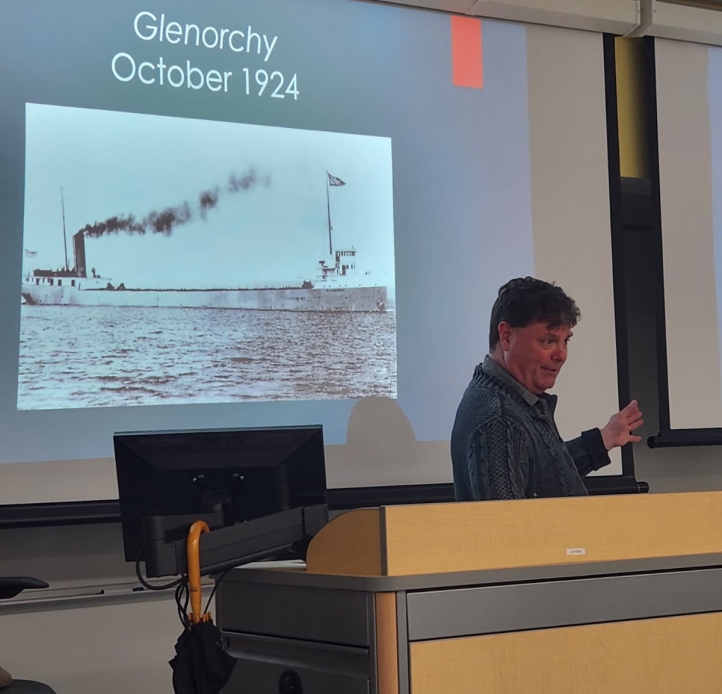
Our first Experience was led by Dr. Andrew Nicholls, professor and chair of History and Social Studies Education, who gave a talk about Great Lakes shipping and shipwrecks in “Glenorchy’s Lost Grain” on March 11th. Despite the risks of shipping in an age without sophisticated communication, radar, or accurate weather forecasting, shipping by boat was long seen as safer than transporting large shipments overland. Nicholls related how shipping shaped his hometown of Midland, Ontario. He led us through some shipwrecks, including the most famous Great Lakes shipwreck, the Edmund Fitzgerald (1975, Lake Superior), and the Tewksbury Incident (1959, Buffalo, NY). Nothing dramatic happened during the shipwreck of the Glenorchy (1924, Lake Huron). During a thick fog, the ship collided with a larger freighter that rescued the entire crew, but the full shipment of grain was lost. The wreck could have faded into obscurity if not for a lengthy court battle between the companies that insured the grain. The U.S. Supreme Court ruled in Standard Marine Ins. Co. vs Scottish Metropolitan Assurance Co. (1931) that the value of the shipment is established at the time and place of shipment, not the destination, and thus the company that insured the goods at departure received their share of the damages first and any remainder was given to the insurer of the profits. The other reason this wreck did not fade is that the grandson of the chief engineer of the Glenorchy became a historian, Nicholls, who wrote about the shipwreck, talked about it with the interim director of the GLC at Campus House one fall afternoon, and went on to give this presentation.
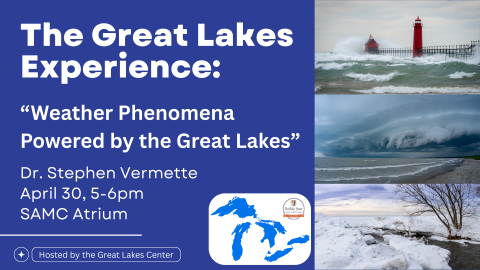
The next Experience is scheduled for April 30th, at 5:00 pm in the SAMC Atrium, when Dr. Stephen Vermette of Geosciences will present “Weather phenomena powered by the Great Lakes.” A series of posters will be available to peruse and discuss, examining lake effect snow bands, storm formation, the oasis effect, the leeward side, meteotsunamis, seiches, ice formations, and optical mirages.
In the fall semester, look for three more events: “Burchfield’s aesthetic history of the Great Lakes region,” by Tullis Johnson, Curator of the Burchfield Penney Art Center; “Folklore of Lake Erie,” by guest speaker Judith Neulander, co-sponsored by Anthropology; and “Salmon, spirits, & steak: Exploring Great Lakes food and agriculture,” by Michael Ferraro of Hospitality and Tourism.
New Buffalo buoy updates
by Brian Haas and Ben Szczygiel
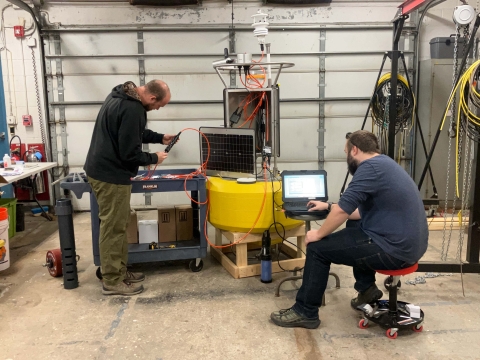
The new Buffalo weather buoy arrived at the Field Station in the beginning of March and assembly is underway! Sensors and electronics have been calibrated and installed into the system, and the underwater components and mooring construction will be completed during April. A new buoy webpage is under development, and we’ve designed outreach materials that are being printed. Another pre-deployment visit to the buoy site is needed when conditions allow, where final measurements will be taken in the water to confirm mooring and temperature profile specs. Vessel modification is also underway to make in-house mooring deployment and retrieval possible. The anticipated deployment date will be in late spring, at which time data for this buoy will be available via Seagull.
Winter’s Last Breath
by Kit Hastings
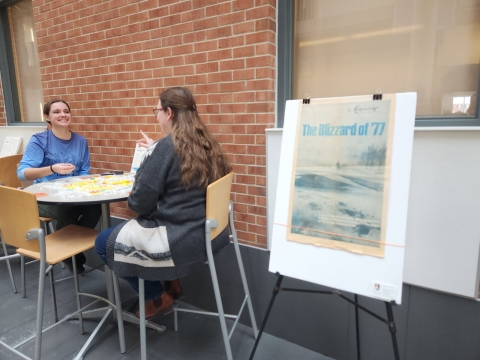
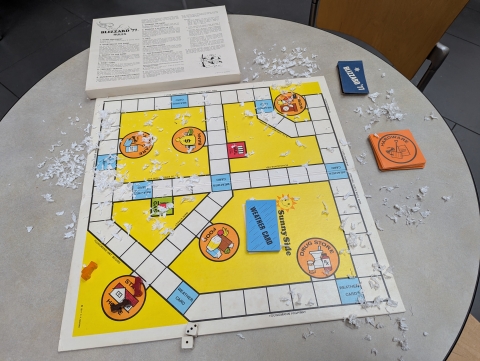
The GLC and Geosciences hosted an event for students on February 12th. Planned by Kit Hastings, Susan Dickinson, and Dr. Stephen Vermette, “Winter’s Last Breath” featured winter-themed games and snacks for student fun and posters on the Blizzard of ’77, lake effect snow, and Groundhog’s Day. Two games were available: cornhole with plush snowballs instead of bean bags and the Blizzard of ’77 boardgame. Students who played cornhole won globe keychains. The board game had a double-sided board, demonstrating easier navigation on the “sunny side” and increased obstacles after the storm hit. Players traveled around the board completing errands before returning home. Event cards helped gameplay but also told stories from the historic snowstorm. For snacks, there were Snoballs and Snocaps. Tables were decorated with Buffalo Snow, a fake snow made in Depew, NY.
Originally, the event was planned for the Week of Welcome, a series of programs to welcome students during the first week of the semester. In fact, the event was to coincide with the Blizzard of ’77 anniversary on the 26th of January, at 11 am. Perhaps hosting the event on the exact anniversary was doomed to fail, as classes were cancelled that day for snow cleanup after a winter storm. Instead, we waited until after Groundhog’s Day, when various famous marmots prognosticated on the arrival of spring. There has been some snow since our event, but that was the last major snowstorm in a very snowy winter. It was nice to celebrate winter with a little fun and more distance from snowstorms!
News highlights
by Kit Hastings
Alexander Karatayev and Lyuba Burlakova’s 2024 paper, “Natural Enemies of Zebra and Quagga Mussels: Predators, Parasites, and Ecological Competitors,” was ranked #3 on Reviews in Fisheries Science and Aquaculture’s “Most downloaded articles of the past 12 months” list. They were also interviewed for an article in the Washington Post in September 2025, “‘Prolific alien invaders’ threaten waters in the West.” Interim Director Chris Pennuto’s 2025 paper “Mass loss and nutrient release of sloughed Cladophora” was included in BioOne Complete’s January 2026 Top & Trending Research Collection. Affiliate Dr. Tao Tang from Geosciences published a textbook, Fundamentals of Geographic Information Systems (GIS) Analysis: Applying ArcGIS Pro.
A study in the Journal of Great Lakes Research did an environmental scan of 22 Great Lakes water research centers, including the GLC, looking at their structures and the factors that influence their success. The water centers focus on different areas of research but collaboration between them allows their expertise to complement each other. New water centers have been founded steadily every few years since the 1960s. According to author Michael Twiss, one thing the water centers could do better is addressing Indigenous concerns.
Due to La Niña and a negative North Atlantic Oscillation, ice cover in the Great Lakes was the highest it’s been since 2019. Ice cover peaked on February 9th, with 96% in Lake Erie and 58% across the entire region. Despite the cold winter, average ice cover is still declining by about 5% every decade due to global climate change. Good news, however! The Lake Erie Niagara River ice boom was being removed on the week of April 6, a regional sign of spring.
All about the odor: Searching for new invasive crayfish management tools
by Dr. Chris Pennuto
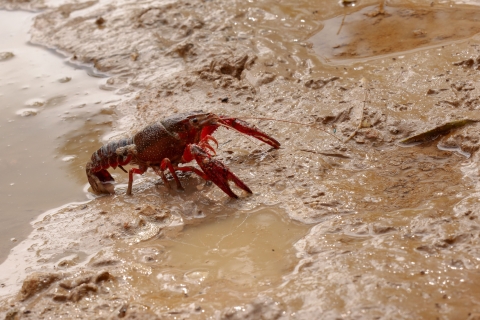
Invasive species are a major threat to ecosystems around the world. One recent arrival is the red swamp crayfish (Procambarus clarkii), now established in two locations of Western New York. Traditional management tools include educating potential introduction sectors like the aquarium trade or live-bait industry to reduce spread. Once they have arrived, intensive trapping programs, or even pond draining and filling are often employed. Recently, GLC Interim Director Dr. Chris Pennuto and collaborators Drs. Jinseok Heo and Sujit Suwal from the Department of Chemistry were awarded a grant to try and isolate mating pheromones of this pesky crayfish to improve management efforts.
Chemical communication is a critical signaling mode for aquatic animals, and one that researchers are investigating for possible development in invasive species management. Scent recognition is essential for a wide range of behaviors critical to survival. Odors allow individuals to attract or locate potential mates, find food and avoid predators, complete migrations, or aggregate with conspecifics. If we can identify, isolate, and verify specific odors triggering these behaviors, it may be possible to design new management tools that direct invasive species to locations we want them to go or to deter them from locations we don’t want them to be. That is the ultimate goal for this new research award.
Dr. Pennuto and his graduate students have been investigating red swamp crayfish predator avoidance and competition behaviors for a number of years and trapping local populations to reduce numbers. This new research endeavor may lead to further reductions in numbers. But isolating putative bioactive compounds that might trigger mate searching or mating behavior is tricky business. Dr. Heo suggested that “by using bioassay-guided fractionation and high-resolution mass spectrometry, we believe we can identify the chemical signals that attract crayfish and apply this knowledge to improve control strategies while providing students with hands-on research experience.” This research showcases complimentary disciplinary science that will need both some biological confirmation of mating behavior and attraction, as well as detailed chemical analyses to isolate specific compounds. The work will be funded by the NYS Department of Environmental Conservation.
Exploring voxel layers for geospatial imaging
by Dr. Tao Tang, GLC affiliate
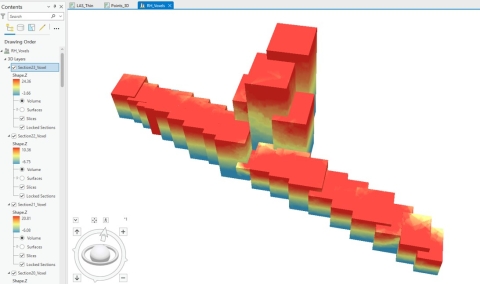
Dr. Tao Tang of the Geosciences Department is conducting a study to convert field-collected data into a new 3-dimensional GIS data model called a voxel layer. Voxel layers are a digital LEGO type of data structure that can be used to illustrate distributions of environmental factors, such as ocean or Great Lakes water temperature or salinity. It can make distributional movies of environmental factors to show changes over time as well. Although the development of the voxel layer is still in the early stage, it shows potential to represent and simulate real-world environmental conditions in the digital environment.
Seven years of WNY PRISM’s Watercraft Inspection Stewardship Program
by Nick Farese
The WNY PRISM region is home to many outstanding water resources. While watercraft make it possible to enjoy them, they can also unintentionally spread aquatic invasive species (AIS). To address this threat, watercraft inspection programs have become a standard prevention strategy employed across New York State. These programs aim to stop the spread of AIS and educate the public on why prevention matters and how simple, everyday actions can make a meaningful difference.
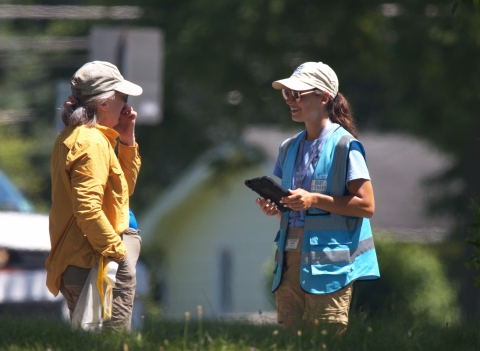
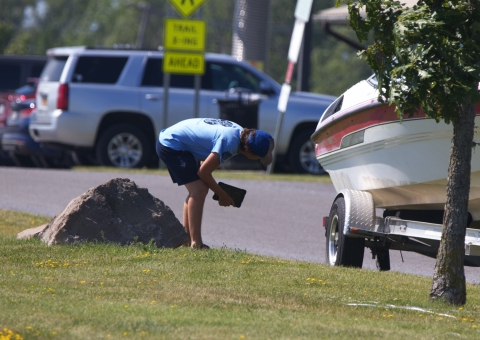
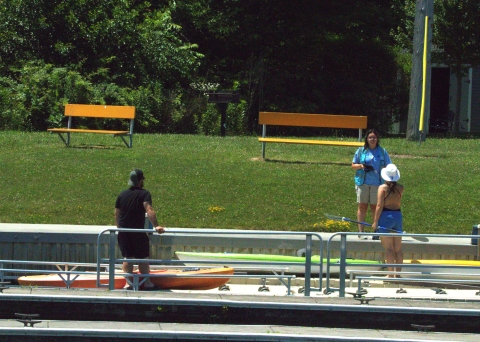
WNY PRISM’s Watercraft Inspection Stewardship Program (WISP) was established in 2018. The program stations trained Watercraft Inspection Stewards/Environmental Educators (stewards), at priority boat launches throughout the WNY PRISM region from Memorial Day through Labor Day. Stewards conduct voluntary inspections, collect survey data on boating activity, and provide outreach about invasive species prevention and WNY PRISM’s work. In 2019, WNY PRISM staffed twenty-two launches, with several stewards splitting time between multiple launches. Since then, the program has gone through changes and in 2025 we operated at twelve launches. This strategic shift allowed WNY PRISM to focus efforts on higher priority sites, including high-traffic launches, waterbodies with known invasive species concerns, areas at risk of new introductions, and locations offering greater outreach opportunities.
Since the program’s inception, stewards have interacted with 235,273 members of the public, inspected 102,575 watercraft and intercepted 6,570 confirmed aquatic invasive organisms representing twelve species. Unsurprisingly, in 2020, when everyone was eager to get outside, WNY PRISM experienced its busiest season, with 53,257 interactions, 12,886 inspections, and 1,309 aquatic invasive organisms across six species. Even in an average season, however, the program conducts 30,089 interactions, 13,472 inspections, and intercepts 832 invasive organisms, demonstrating its consistent regional impact.
Sturgeon Point Marina, located on Lake Erie, is a great example of what a watercraft inspection stewardship program can provide. Lake Erie supports world-class fisheries, which attract anglers and boaters from across the region and beyond. Patrons of the marina have reported previously launching their watercraft in waters across ten different states and one Canadian province, with one boat arriving from as far away as California! This level of boat traffic creates significant opportunities for AIS to spread. Over six seasons of staffing at the marina, stewards have interacted with 29,645 individuals, conducted 11,547 watercraft inspections, and intercepted 1,827 aquatic invasive organisms across seven species. This accounts for over 12% of total public interactions and 27% of the aquatic invasive organism interceptions in the region, underscoring the importance of consistent watercraft inspections and the adoption of "Clean. Drain. Dry." practices.
WNY PRISM will continue operating our Watercraft Inspection Stewardship Program in 2026! This season, stewards will staff twelve launches across five counties in Western New York. To learn more about WNY PRISM and WISP, visit www.wnyprism.org.
Originally appeared in the WNY PRISM Spring Newsletter (PDF). Republished with permission. Photo credit: WNY PRISM.
GLES student spotlight: Richard Campbell
by Dr. Chris Pennuto
The Great Lakes Environmental Science graduate program opened its doors in 2013. Since our first graduates left us, they have been making meaningful contributions in their field. This column is an opportunity to highlight the accomplishments of some those students, past or present.
Richard Campbell will complete his GLES M.S. degree in spring 2026. What a journey he has had. After an earlier career as an environmental technician supporting inspections and approvals needed for concrete and asphalt projects, he joined the Great Lakes Environmental Science program in Fall 2024. The return to academia required some discipline and a rekindling of the need for reading and reflection of current literature in the environmental science and ecology fields. He reflected that he was “reintroduced to scientific discussions and critical writing techniques after being outside of the academic world for the past few years” and these activities were both a little rusty, but fun to reengage with. He also provided a bit of wisdom for others that might not want to risk being engaged in class when he commented that “I love raising my hand and being wrong, it just means I get to learn something new.”
As part of his graduate program, Richard completed an internship with the Town of Tonawanda, Municipal Water and Sewer Department (and one he is continuing this spring). Richard applied GIS skills gained in his program to update and map sewer access points throughout the entire municipality. These location points and maps are a critical data piece as the Town lines their pipe infrastructure to reduce leaks and contamination events. He also was part of a small project investigating differences in the sediment depth at which starry stonewort bulbils (Nitellopsis obtusa) were found among multiple sites in the Niagara River corridor. His research group verified that these bulbils rarely are found below the first 4 cm of accumulated sediment in those areas where known infestation occur, suggesting either very high germination rates, high erosion habitats, or other mechanisms that prohibit long-term accumulations. He is another success story for our young graduates. We wish him the best in all his future endeavors.