
First Issue of the GLC Newsletter
November 12, 2012
The Great Lakes Center is pleased to announce the first issue of our semiannual newsletters. The main goal of these newsletters is to give an update on our activities for the past 6 months to our friends, colleagues, and anyone else who’s interested in what we do. We normally produce an Annual Report at the conclusion of each fiscal year, but adding two newsletters a year should allow us to focus on everything that happens in between. One issue will be released in the fall after our field work has been completed, and the other will come out in the spring.
Since this is our first newsletter, please feel free to give us feedback and suggestions for future issues. If you would like to submit content for the spring issue, please contact us.
Welcome to our newsletter
by Alexander Karatayev
The Great Lakes Center is pleased to announce the first issue of our semiannual newsletters. The main goal of these newsletters is to give an update on our activities for the past 6 months to our friends, colleagues, and anyone else who’s interested in what we do. We normally produce an Annual Report at the conclusion of each fiscal year, but adding two newsletters a year should allow us to focus on everything that happens in between. One issue will be released in the fall after our field work has been completed, and the other will come out in the spring.
The Annual Report is business-oriented, mainly intended for reporting our productivity. These newsletters will have a more informal format for short articles on the progress of our research projects, conferences we attend, and other achievements; to feature student research; and to provide more pictures. Having a digital newsletter will allow us to post it on our website, letting visitors know just what it is that we do here. We will be able to link directly to longer articles and additional content posted throughout our website. It’s also paperless, but still printer-friendly if you would prefer to print it out to read.
Since this is our first newsletter, please feel free to give us feedback and suggestions for future issues. If you would like to submit content for the spring issue, please contact myself or Kit Hastings, the newsletter editor.
LENONS study comes to an end
by Christopher Pennuto
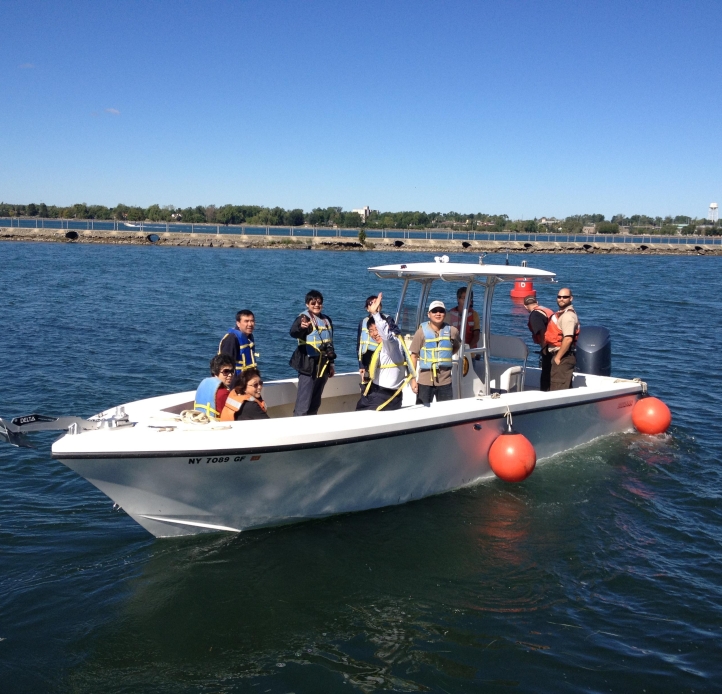
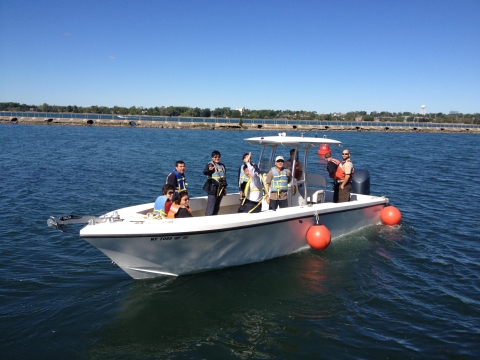
The Lake Erie Nearshore and Offshore Nutrient Study (LENONS), funded by the US EPA and led by GLC biologist, Dr. Chris Pennuto, is coming to an end. The two-year study was a large-scale effort to assess the quantity and movement of nutrients like phosphorous and nitrogen from tributary and nearshore sources through food webs to the offshore. In doing so, the study sought to investigate the occurrence and strength of a nearshore nutrient shunt.
This idea, called the Nearshore Shunt Hypothesis, was proposed by researchers several years ago as a mechanism that might explain why offshore water column nutrient concentrations were decreasing over time even though incoming concentrations were not. The major drivers in this supposed shunt are zebra and quagga mussels (Dreissena spp). These mussels occur in very large numbers, most densely in the nearshore environment, like a bathtub ring of mussels around the lake. They also filter large volumes of water while foraging. These factors may allow them to intercept water column nutrients before they make it offshore.
Pennuto put together a team of researchers with the expertise to address different parts of this hypothesis. Collaborators included experts in water column food webs (Dr. Alicia Perez-Fuentetaja; Buffalo State), dreissenid mussels and benthos (Drs. Lyuba Burlakova and Sasha Karatayev; Buffalo State), nutrient uptake dynamics (Dr. Darren Bade; Kent State), nutrient quantification (Jack Kramer, Heidelberg University), sediment nutrient dynamics (Dr. Gerald Matisoff; Case Western Reserve University), and benthic ecology (Dr. Christine Mayer, University of Toledo).
The Buffalo State part of the team performed or was involved with nearly all of the field collections for the project, providing plenty of work for the Great Lakes Center staff and an array of undergraduate and graduate students. The project was only possible with the support of the Great Lakes Center. Hundreds of nutrient, stable isotope, zooplankton, benthos, and sediment samples were collected and are now being analyzed. Researchers are combining their findings into a Special Issue volume to be published by the Journal of Great Lakes Research sometime in the future. Ultimately, the outcomes may direct new lake-wide management decisions regarding the loading and fate of nutrients in Lake Erie. Pictures are in our Photos section.
Field Station grows: GLC acquires the building next door
by Mark Clapsadl
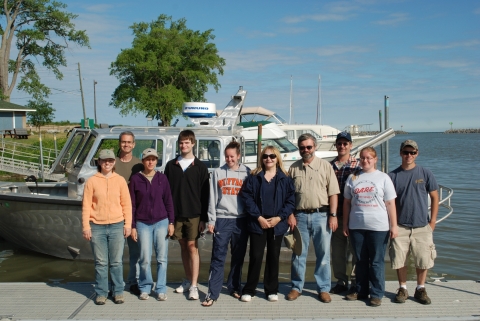
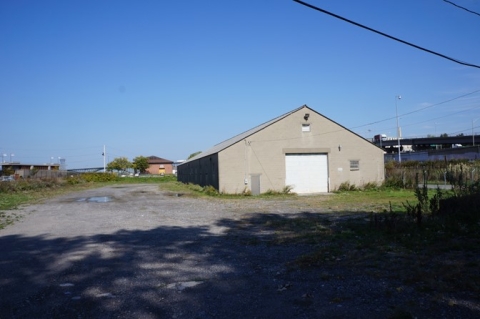
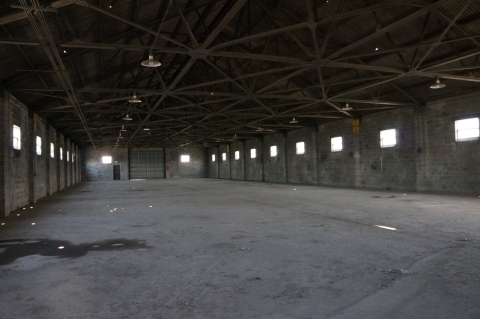
On June 30, 2012, ownership of the concrete block building on the 1.5-acre site adjacent to the Great Lakes Center Field Station was transferred from the Division of Military and Naval Affairs to Buffalo State College. The addition of this acreage and building will prove to be a great asset for the college and the GLC.
In the past several years the GLC has upgraded the fleet of research boats with the purchase of four new vessels. We have also added a number of large buoys that collect limnological and meteorological data during the ice free months on Lake Erie.
These additions are all great, but we outgrew our ability to properly store this valuable equipment during the winter.
With the acquisition of the building and property next door we now have a safe, dry and convenient place to store our research tools. The new building looks plain, but the whole Field Station could likely fit inside. Think of all boats and equipment that will stay out of the elements!
Great Lakes Center Buoys
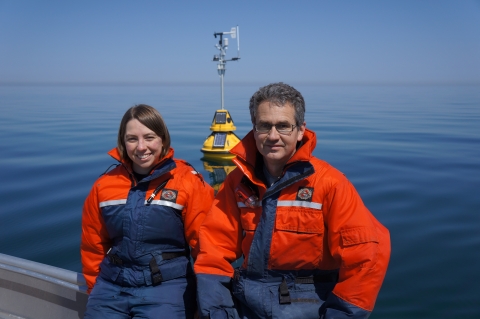
GLOS Buoy
The Great Lakes Observing System buoy was deployed outside Dunkirk, NY for the second year. The buoy collects meteorological and limnological data, which are transmitted to the GLC and the GLOS network via cellular link. It is the only GLOS buoy in eastern Lake Erie.
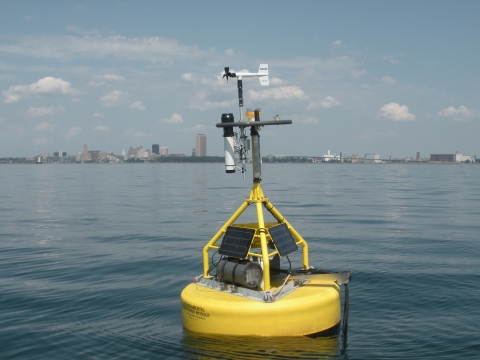
EPA Buoy
The first of three monitoring buoys for an EPA project led by Stephen Vermette was deployed outside Buffalo Harbor this summer.
Fast facts
12
Funded projects
5
Papers published
23
Talks presented
15
Grant proposals submitted
GLC researchers study mussels
by Lyubov Burlakova and Alexander Karatayev
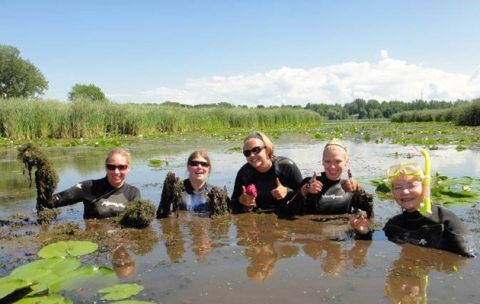
This season, three major mussel projects were continued by Drs. Lyubov Burlakova and Alexander Karatayev. We surveyed molluscan communities in Texas, Lake Ontario, and Oneida Lake, NY.
2012 survey of Texas hornshell populations

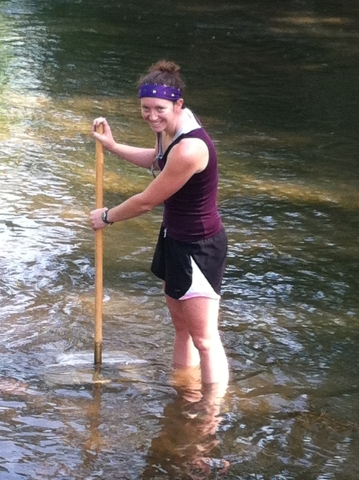
In April 2012, we worked on the Devils River and the Rio Grande on a joint project, “Survey of Texas Hornshell Populations in Texas” (U.S. Fish and Wildlife Service, Texas Parks and Wildlife Department, Buffalo State College and New Mexico Department of Game and Fish, 2011-2013). The purpose of the project is to assess the current distribution of the freshwater mussel Texas hornshell in Texas; evaluate long-term changes in distribution range; locate and describe existing populations; and determine species’ habitat requirements.
Texas hornshell is a regional endemic that has been recently added to the state’s list of threatened species, and is currently a candidate for listing under the federal Endangered Species Act. The favorite habitat for this mussel is very unique: crevices under flat boulders resting on the bedrock. This habitat provides stable substrate and flow refuges for mussels from the tremendous flooding events typical for the Rio Grande.
Devils River is one of the most pristine rivers in Texas, and the area we surveyed was very scenic. However, due to the low water, the trip was also very challenging. For two days of surveys we found four live Texas hornshells, confirming that a very small population has survived in the Devils River.
Later in April, we continued our population study at the mark-and-recapture site in Laredo, home to 8,700 Texas hornshells. We also surveyed a 120 km stretch of the Rio Grande using an airboat, which has proved to be a great water craft for such surveys. During this survey we found mussels on all suitable sites above Laredo, but no mussels were found below the North Laredo and Nuevo Laredo Sewage Treatment Plants despite the abundance of suitable substrates.
Surveys of freshwater mussel refuges in Lake Ontario
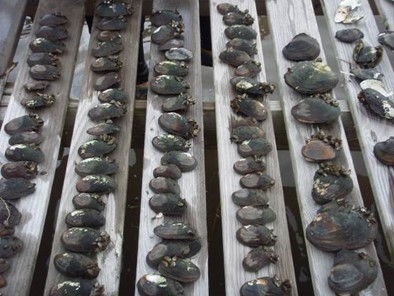
This summer, we worked on a project “Conservation of Native Freshwater Mussel Refuges in Great Lakes Coastal Zones,” funded by Great Lakes Fish and Wildlife Restoration Act. The purpose of this project is to determine if native unionid mussels survived the dreissenid mussel invasion, and to locate possible mussel refuges in the lower Great Lakes. This project is a large collaborative study that includes scientists from 12 universities and federal and state agencies in Michigan, Ohio, Pennsylvania and New York.
In 2011, we surveyed Lake Erie and St. Clair and found that despite a sharp decline in the diversity and density of unionids in the Great Lakes associated with Dreissena invasion, native clams survived in many refuges including bays, river mouths, and coastal wetlands. Based on the survey’s data, Jon Bossenbroek (University of Toledo) produced a predictive model for unionid refuges in Lake Ontario, and our goal for the 2012 summer season was to find refuges on the lake and check if this model is working.
During four weeks of surveys, we sampled 56 sites in Lake Ontario and found 1,802 live unionids belonging to 10 species. Preliminary data analysis indicated that infested unionids had fewer attached dreissenid mussels than in the early 1990s, and much lower than the threshold number for causing unionid mortality.
A century of change in the molluscan community of Oneida Lake
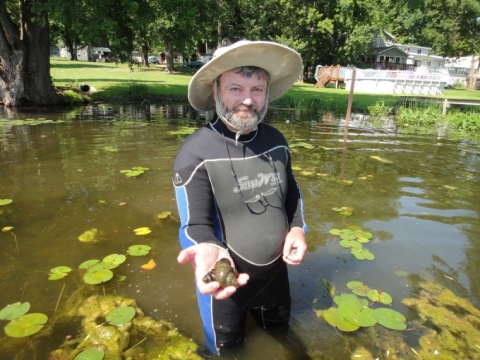
In the summer of 2012, we spent three wonderful weeks at the Cornell University Biological Field Station on Oneida Lake doing an extensive mollusc survey and enjoying the warm hospitality of its faculty, staff, and especially the Station’s Director, Lars Rudstam. This trip was a result of several discussions with Lars in the preceding years about a potential collaboration between the Great Lakes Center and the Cornell Biological Field Station at Shackelton Point to understand the possible reasons for the decline in the molluscan diversity in Oneida Lake.
This lake was a subject of multiple studies at the beginning of the 20th century conducted by a prominent malacologist Frank Baker. According to Baker, at that time, this lake hosted an abundant and diverse molluscan community of 41 species, including 12 unionid bivalves. Now, due to habitat loss, the introduction of invasive species, and other results of human activity, the diversity of molluscs has dramatically declined. We found that at least 34 species of molluscs are currently present in Oneida Lake, including an exotic snail, Chinese mystery snail, which we found in the lake for the first time. At the same time, all native Unionidae have been extirpated from the lake, most likely due to the impact of dreissenids.
New graduate programs coming in 2013
by Alexander Karatayev
The Great Lakes Center, in conjunction with the Departments of Geography & Planning, Earth Sciences, Biology, and the Dean’s Office, has made significant progress toward developing two new graduate programs in Professional Science Master and Master of Science in Great Lakes Ecosystem Science. These degrees build upon an effort begun nearly a decade ago to create a Great Lakes-focused graduate research degree.
The programs will be able to accommodate a range of students and faculty outside the GLC, but will still lean toward our core interests. The locale and facilities of Buffalo State College provide a unique opportunity to study the effects of the interactions of physical and biological processes with social, economic and civil activities of the humans living on one of the world’s most precious resources - fresh water. We are planning to recruit the first students into these programs in the fall of 2013. For more information on the new programs, please visit our website or contact: Alexander Karatayev, Program Coordinator, karataay@buffalostate.edu.
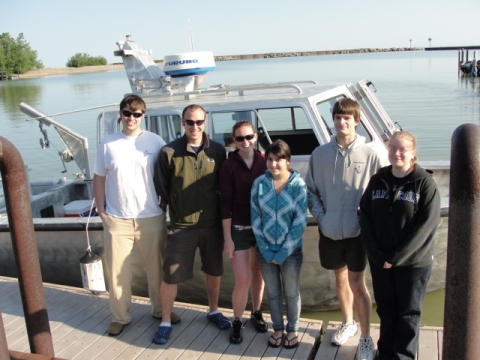
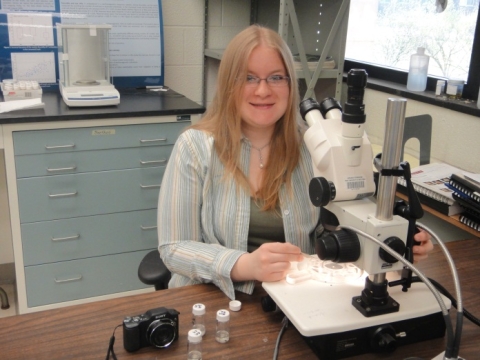
View from the water's edge
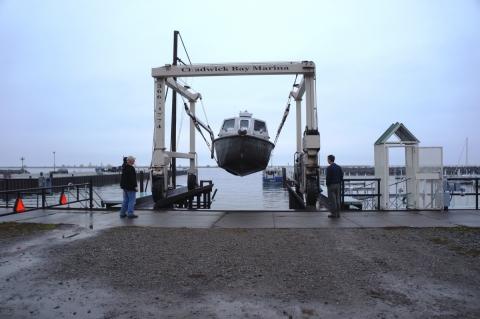
Lifting the R/V John J. Freidhoff
Water levels in Lake Erie are so low that when Mark and Kit went to Dunkirk to retrieve the GLOS buoy this October, the marina had to lower the boat into the water, instead of using the public boat launch.
Low water levels at the Field Station impact launching
Water levels at the Field Station are typically lower in the fall, but this year it’s extreme. The waves normally lap at the edge of the concrete pad on the far right. Only two feet to the left of the current water level, the launch ends and drops off into deeper water.
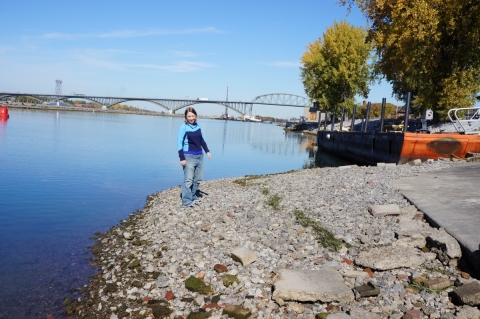
Uncovered for the first time
These old dock pilings are normally underwater to about the level of Mark’s waist. Being submerged has helped preserve the decades-old remnants. Being exposed to the air for prolonged periods will accelerate their decay.
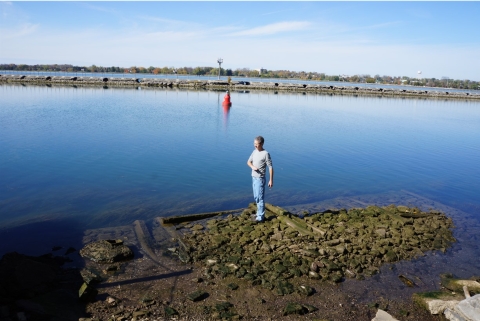
More pictures of this fall's low water at the Field Station are available in Low water at the Field Station 2012 and Low water affects boat launching in Dunkirk.
More sights of the summer
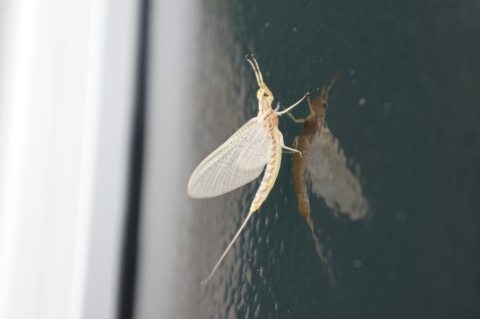
Mayfly hatch
This summer was excellent for insects. Of the many emergent species, chironomid midges did the best by far. However, we also saw plenty of the rarer mayflies.
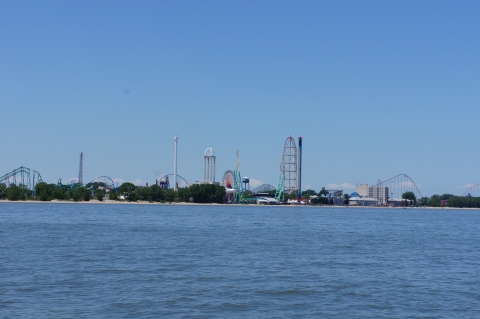
Cedar Point
One of the LENONS sites was just outside Sandusky, Ohio. In order to reach our sample sites, we had to pass by Cedar Point. We were close enough to hear music from the rides and the screams of park patrons.
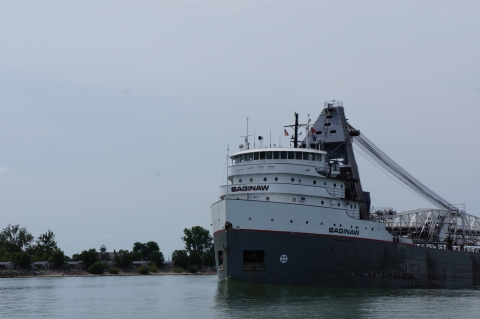
Great Lakes freighter
In Sandusky, we also saw the freighter Saginaw close-up. Great Lakes freighters are hundreds of feet long and very impressive, but it’s hard to capture the full magnitude in one image from boat level.
More images in the slideshow Other sights of LENONS.
Impacts of calcium depletion and food availability on Daphnia
by Fawn Goodberry and Alicia Pérez-Fuentetaja
Daphniids are an important component of many aquatic ecosystems. They are keystone herbivores in pelagic food webs and are a food source for fish.
Acidification of soft water lakes can significantly affect the growth and reproduction of Daphnia species and the ecological communities they are a part of. Acidification alters the availability of many nutrients in soft-water boreal lakes. Acid stress accelerates the leaching of calcium from soils and surface waters and eventually results in a calcium deficiency in lakes. This effect can be even more pronounced depending on geographical regions and degree of forest harvesting, as tree removal from a watershed also removes the calcium contained in the trees.
Most calcium in Daphnia is part of the carapace, or exoskeleton, and it comes primarily from the surrounding water. Because Daphnia use calcium to build their carapaces and they replace them regularly during their life, the uptake of calcium is critical for their growth and reproduction.
This research was motivated by the questions: What happens to aquatic invertebrates that need calcium for their life processes when calcium is declining in their environments? And what happens to these organisms when, in addition, their food sources become altered?
In soft water lakes, Daphnia species are at risk, as the combined effects of acidity, low calcium and changes in food sources could result in an overall reduction in their populations. The reduction of these populations or their disappearance from the aquatic food web would result in drastic effects up the food web, affecting vertebrates such as fish and changing the ecology of whole lake ecosystems.
This work comes from Fawn’s M.A. thesis project, “The interaction of Calcium depletion and food availability on the survival and reproduction of the freshwater cladoceran Daphnia.” Dr. Alicia Pérez-Fuentetaja is her thesis advisor.
The round goby upstream invasion
by Christopher Pennuto
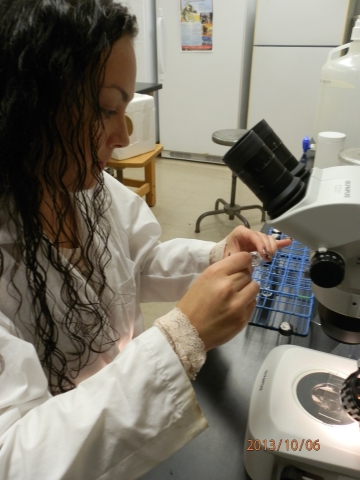
GLC biologist Dr. Chris Pennuto and his students are keeping their eyes on a little fish invader now present in many Great Lakes tributary streams. The round goby (Neogobius melanostomus) showed up in the Great Lakes nearly twenty years ago, and in the last decade has begun invading tributary streams. Dr. Pennuto, plus former and current graduate and undergraduate students Chris Janik, Kevin Cudney, Allyse Fischer, Shana Chapman, Vanessa Pereira, Shannon Rupprecht, Amelia Brown, and Peter Krakowiak have investigated various aspects of the ecology of this benthic fish, and its impacts to stream ecosystem dynamics.
Their work has shown several different things. Round goby spawning in tributary systems represents another potential source of young fish entering the Great Lakes. These fish may be capable of bypassing small waterfall barriers, threatening upstream areas safe from other invading fish. Round gobies consume a significant fraction of the available insect biomass in streams, and this consumption leads to both a reduction in leaf decomposition rates and an increase in periphyton biomass.
Current graduate student, Allyse Fischer, and undergraduate student and URM fellow, Vanessa Pereira, are taking the decomposition story a step further by determining if round gobies not only affect leaf decomposition by altering the insect community composition and abundance, but also by somehow affecting the microbial community within leaf packs.
As scary as that might seem, Allyse and Vanessa have been diligent in their hunt to understand this haunting invader.
Get involved
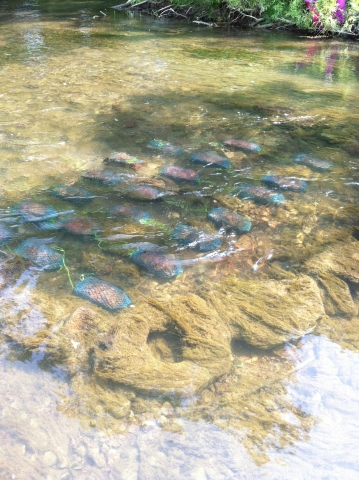
If you are interested in doing undergraduate or graduate research with the Great Lakes Center, contact one of our staff or affiliated professors in the Biology or Geography and Planning departments.
Buoy evidence may explain summertime fish kill
by Mark Clapsadl
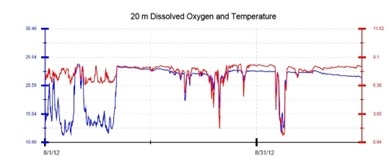
This summer data from the GLOS buoy proved useful in explaining a “mystery” fish kill that occurred in early September. Late during the summer of 2012 there were multiple news reports of a large fish kill, with thousands of fish washing up on Canadian shores. The cause of the die-off was not immediately apparent to Canadian authorities and became a target of speculation for the news media.
There can be many causes for a fish kill, including disease outbreaks, spawning stress, or temperature stress. However, one of the most common events that can trigger a fish die-off in Lake Erie is a seiche. A seiche is a wind-driven event that can keep the lower stratified layer in motion long after the water at the surface has stopped rocking. Some lakes have strong stratification with a relatively warm surface layer above colder water and little or no mixing between them. In Lake Erie it is not unusual during the summer to see the lower layer experience oxygen depletion as bacterial processes use up the available oxygen. The resulting layer of cold oxygen-depleted water can become uninhabitable for most fish. Normally this isn’t a problem since the process is usually fairly slow so fish can move to waters that have better conditions. However, a seiche can force cold low-oxygen water rapidly up into a large area of the lake, effectively trapping fishes. When this happens the results can be dramatic, with thousands of fish dying all at once.
When we first heard reports of dead fish showing up on the Canadian shore we examined our buoy data to see if there was any evidence of a seiche event. The figure above shows an event that began at our buoy early on September 3, 2012. The dissolved oxygen concentrations (DO) began to drop and within 2 hours, the levels of DO went from 8.2 mg/L to 3.5 mg/L. Most fishes cannot tolerate levels below 5.0 mg/L for an extended time. The DO levels briefly rose back up before plunging back down to a low of 1.6 mg/L, well below the tolerance of Great Lakes fishes. Very low DO conditions persisted for about 20 hours.
The water temperature followed an almost identical pattern. It went from 23.0 °C down to 17.1 °C in just 2 hours, and then briefly back up before falling to 13.2 °C for about 20 hours. These conditions observed near the center of the lake are strong evidence of a significant internal seiche.
Within just a few days the first news reports started to come out describing both a strong odor and large numbers of dead fish.
What likely happened in Lake Erie on September 3, 2012 was that an internal seiche drove cold, oxygen-poor water up from deeper portions of Lake Erie into shallower waters. Fish present in these shallow waters that were not able to move out were then killed either because of low oxygen levels or by the shock of rapid large temperature changes, or by a combination of the two factors.
Oftentimes a seiche has little or no impact on the fish community. Even when there is stratification not every seiche event will result in fish mortality. For example, there were also rapid temperature drops seen in early August indicating that a seiche occurred weeks earlier, yet there were no reports of fish kills. Similarly, there were some events where oxygen levels fell for brief periods in late August. It appears that the seiche activity in August was simply not powerful enough to force oxygen depleted water far enough up or for long enough to kill large numbers of fish.
Role of p34cdc2 in cell response to PAHs
by Jagat Mukherjee
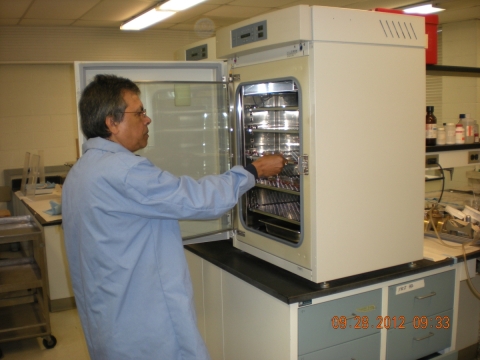
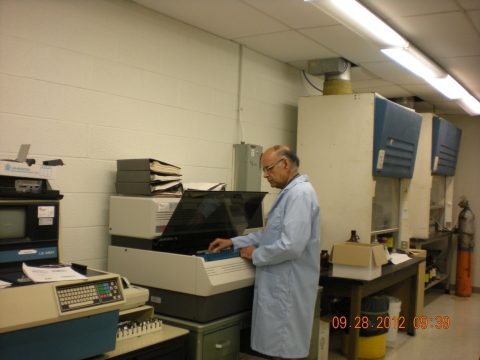
The main research interest of the GLC Environmental Toxicology and Chemistry Laboratory is in the area of chemical carcinogenesis elicited by environmental pollutants known to be present in Great Lakes tributaries. The primary focus of the research is to get an insight of the underlying mechanism and to identify the signaling molecule(s) for chemo-preventive targets.
One of our current research projects is to decipher the role of the p34cdc2 gene in triggering a cell-protective response of cell growth inhibition when in contact with the wide-spread environmental pollutant polynuclear aromatic hydrocarbons (PAHs). This project is directed by Jagat J Mukherjee as PI. Subodh Kumar, the interim Director of the lab, is the co-investigator of this project. A brief summary of the initial findings of the project is given below.
DNA damage by polynuclear aromatic hydrocarbons (PAHs) is known to trigger a cellular-protective response of cell growth inhibition. Our previous observation showed G1-S cell-cycle arrest (inhibition of DNA synthesis) in human fibroblast. Cell growth inhibition is associated with the accumulation of p53 protein, a known cell growth inhibitory transcription factor, in response to treatment with BPDE (ultimate carcinogenic metabolite of the PAH benzo[a]pyrene).
Our present observation shows that BPDE treatment triggers a variable extent of cell growth inhibition in different cell lines. Contrary to our expectations, the extent of cell growth inhibition in different cell lines does not correspond to the extent of increased p53 accumulation.
We also observed that BPDE treatment of cells significantly down-regulates expression of p34cdc2, a known cell cycle activating protein. Although the role of cdc2 down-regulation in inhibition of cell cycle progression is well known, to the best of our knowledge cdc2 down-regulation in response to cellular insult by PAHs has not been reported.
We observed correspondence between the extent of cell growth inhibition and the extent of cdc2 down-regulation by BPDE in different cell lines, as opposed to p53 accumulation as mentioned above. Interestingly, BPDE-mediated cdc2 down-regulation is observed to be p53 dependent although the extent of p53 accumulation does not correspond to the extent of cdc2 down-regulation. However, the extent of cdc2 down-regulation corresponds to the extent of accumulation of cell cycle inhibitor protein p21 (transactivation product of p53) in different cell lines.
These findings may have an implication that cell growth inhibition in response to DNA damaging PAHs may involve down-regulation of cdc2 protein elicited by p53 activation (transactivation ability), and the extent of p53 accumulation is not the determining factor in this regard.
Editor's note
by Kit Hastings
I hope you’ve enjoyed our first newsletter. It’s just one facet of a recent revitalization of our outreach efforts. By increasing our digital presence we’re increasing our visibility to students, collaborators, and the general public.
Over the past few years, I’ve been helping redesign the GLC webpage. Technology has had many advances since our webpage was designed almost 10 years ago. If you recall, it was mostly text-driven with the occasional thumbnail picture. The new layout is easier to update, with more pictures than ever. It’s so much more meaningful to show you how we do our research rather than just listing our accomplishments.
This year, the Center purchased a new camera and I’ve been making a steady effort to document our research activities. The camera takes great videos, too, so we can share our research in ways we never could before. This summer was the first time I’ve taken any videos, so I will continue to upload them over the next month.
How does this newsletter fit into all this talk about the website? In putting it all together, I’ve threaded links throughout the newsletter to additional web content. The website is wonderful and I want to be able to show it off to you! This wouldn’t have been possible with a traditional printed newsletter.
Fall means the end of our field season, so we’ve begun putting the boats and buoys in winter storage. That doesn’t mean that our work is done. We’ll be working in the lab over the colder months, writing papers and submitting proposals for next year. In the meantime, visit our photo gallery to see the new pictures. You can also read about our most recent publications and the six posters we presented at the 13th Annual Faculty/Staff Research and Creativity Fall Forum.
We’ll see you in the spring!