

Ceraclea sp.
-
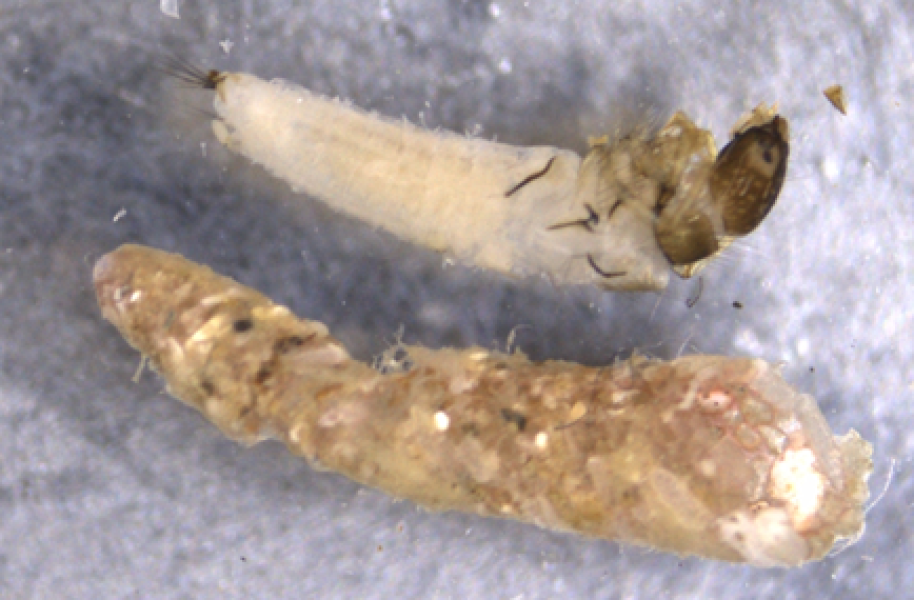
1/2
Figure 1. Larvae and case of Ceraclea sp., note the dark curved bars on weakly sclerotized plates. This individual was found in Saginaw Bay, near Lake Huron in July 2022.
Download Image -
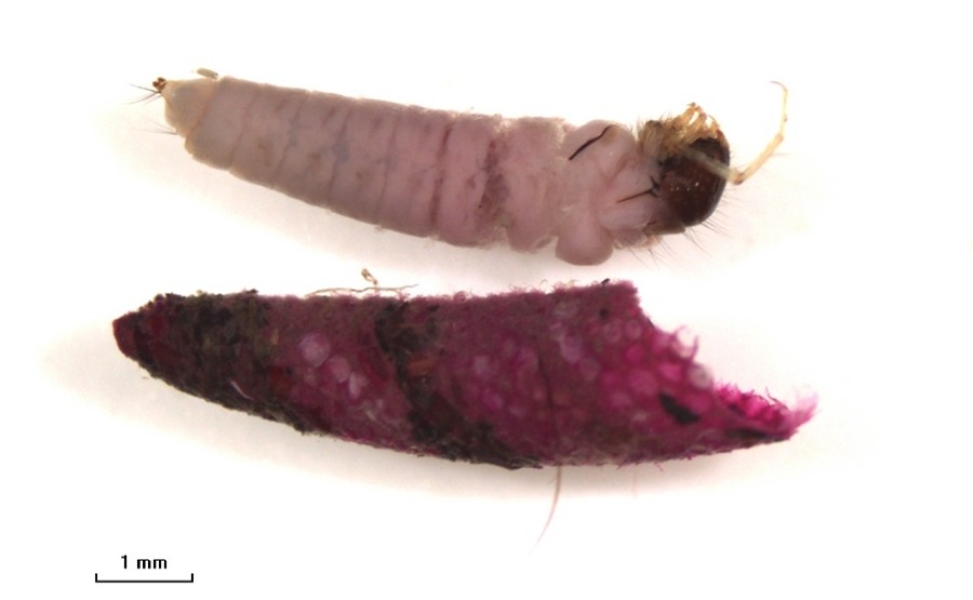
2/2
Figure 2. Larvae and case of Ceraclea spp., note the dark curved bars on weakly sclerotized plates. This individual was found in Lake Erie in July 2024.
Download Image
Ceraclea sp.
Taxa description
Ceraclea sp. is a Trichoptera in the subfamily Leptocerinae. Ceraclea larvae are characterized by having stout bodies with the first abdominal segment as the widest point. The abdomen is broad basally and tapering posteriorly with abdominal gills usually occurring in clusters of 2 or more. The ventral apotome of the head is crescent-shaped and greater in width than length. Mesonotum on Ceraclea has a pair of dark, curved bars on weakly sclerotized plates (Figure 1). The length of the larvae can be up to 12 mm. Cases are wide anteriorly, tapered sharply, and curved toward the rear. Cases are composed of sand grains, occasionally with pieces of freshwater sponge, with an overhanging dorsal lip and can be up to 13 mm in length (Wiggins 1996).
Distinguishing features
Ceraclea sp. is characterized by stout bodies with wide first abdominal segments, broad basally and tapering posteriorly, abdominal gills occur in clusters of 2 or more. The ventral apotome is crescent-shaped and wider than long. There is a pair of dark, curved bars on the weakly sclerotized plates of the mesonotum. The cases, constructed of sand and occasionally freshwater sponge pieces, are wide anteriorly, tapered, and curved toward rear, with an overhanging dorsal lip.
Habitat
Ceraclea larvae inhabit both lentic and lotic waters, and most species are restricted to rather narrow limits within its range (Resh and Unzicker 1975).
Lake occurrence
This species occurs in all five Great Lakes.
Similar species
Relative size
Ceraclea sp. can be up to 12 mm, with cases up to 13 mm.
Does it have a barcode reference from the Great Lakes?
References
Merritt, R. W., and Cummins, K. W., Eds., 2008. An introduction to the aquatic insects of North America. Kendall Hunt.
NOAA and USEPA. 2019 Great Lakes Waterlife. Accessed on 09/05/2023.
Resh, V.H. and Unzicker, J.D., 1975. Water quality monitoring and aquatic organisms: the importance of species identification. Journal (Water Pollution Control Federation), pp.9-19.
Wiggins, G. B., 1996. Larvae of the North American caddisfly genera (Trichoptera). University of Toronto Press.
Occurrence in scientific literature
Davis, B. M., Hudson, P. L., Armitage, B. J. 1991. Distribution and abundance of caddisflies (Trichoptera) in the St. Clair-Detroit River system. J. Great Lakes Res. 17(4), 522-535.
Cooper, M. J., Uzarski, D. 2016. Invertebrates in Great Lakes marshes. In Batzer D., Bolx, D. (Eds.). Invertebrates in freshwater wetlands an international perspective on their ecology, Springer, New York, pp. 287-320.