

Banksiola sp.
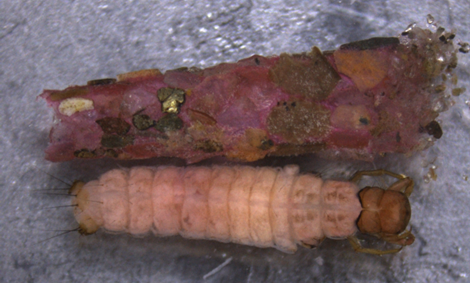
Banksiola sp.
Taxa description
Banksiola sp. Martynov 1924 is an exclusively Nearctic genus of freshwater Trichoptera in the subfamily Phryganeidae. The distinguishable characteristic of all known Banksiola is the dark meso- and meta-notal bands that occur (Fig. 1). Some Banksiola species larvae possess a median dark band on the frontoclypeal apotome, however, this is absent in B. crotchi. Banksiola has a more distally expanded tibiae of the fore and middle legs when compared to other Phryganeidae genera. Another Nearctic Phryganeidae genera, Oligotricha, is also characterized by bands and distally expanded tibiae but Oligotricha is confined to western Alaska and does not have trailing ends on cases (Wiggins 1996). Banksiola is also distinguishable by the presence of anterodorsal gills on segments VI and VII and a lack of posteroventral gills on segment VII (Merritt et al. 2008). The length of the larvae can be up to 22 mm. The larval cases can be up to 45 mm and are constructed of plant material pieces arranged spirally with ends often trailing (Wiggins 1996).
Distinguishing features
Banksiola sp. is identified by the dark meso- and meta-notal bands, a more distally expanded tibiae of the fore and middle legs when compared to other Phryganeidae genera, anterodorsal gills on segments VI and VII, lack of posteroventral gills on segment VII, and cases made of spirally-arranged plant material pieces with ends often trailing.
Habitat
Lake occurrence
This species occurs in Lakes Huron, Superior, and Erie, as well as the Huron-Erie corridor.
Similar species
Another Nearctic Phryganeidae genera, Oligotricha, is also characterized by bands and distally expanded tibiae but Oligotricha is confined to western Alaska and does not have trailing ends on cases.
Relative size
The length of the larvae can be up to 22 mm. The larval cases can be up to 45 mm.
Does it have a barcode reference from the Great Lakes?
References
Merritt, R.W., and Cummins, K.W. eds., 2008. An introduction to the aquatic insects of North America. Kendall Hunt.
NOAA and USEPA. 2019 Great Lakes Waterlife. Accessed on 09/05/2023.
Wiggins, G.B., 1996. Larvae of the North American caddisfly genera (Trichoptera). University of Toronto Press.
Occurrence in scientific literature
Cooper, M.J., and Uzarski, D.G., 2016. Invertebrates in great lakes marshes. Invertebrates in Freshwater Wetlands: An International Perspective on their Ecology, pp.287-320.
Davis, B. M., Hudson, P. L., Armitage, B. J. 1991. Distribution and abundance of caddisflies (Trichoptera) in the St. Clair-Detroit River system. J. Great Lakes Res.17(4), 522-535.
Masteller, E. C. 1993 b. The Trichoptera (caddisflies) of Presque Isle State Park and Lake Erie, Erie County, Pennsylvania. J. Penn. Acad. Sci., 167, 132-136.