

2012 Survey of Texas Hornshell Populations in the Rio Grande drainage, Texas
May 31, 2012
In April 2012, we worked on the Rio Grande on a joint project “Survey of Texas Hornshell Populations in Texas” (U.S. Fish and Wildlife Service, Texas Parks and Wildlife Department, Buffalo State College and New Mexico Department of Game and Fish, 2011-2013). The main goals of this project are to assess the current distribution of Texas hornshell Popenaias popeii in Texas; evaluate long-term changes in distribution range; locate and describe existing populations, and determine species’ habitat requirements.
The Rio Grande is considered the most endangered river system in the North American continent and one of the world’s top 10 rivers at risk. Freshwater unionid bivalve Popenaias popeii (Texas hornshell), is a regional endemic known from the Rio Grande drainage that has been recently added to the state’s list of threatened species, and is currently considered a candidate for listing under the federal Endangered Species Act. During the first year of this current project (2011) we discovered a large population of P. popeii in the La Bota area (Laredo, Webb Co) that may contain up to 8,700 mussels.

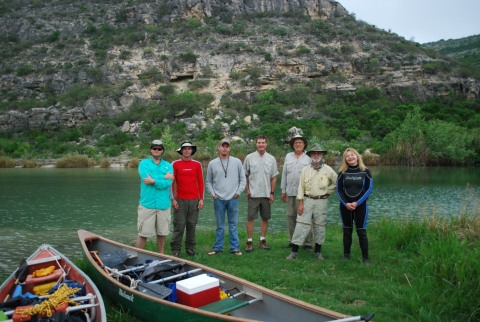
In April 2012, together with our colleagues (Photo 2) we sampled the Devils River from Bakers Crossing to Dolan Falls. Owing to the help of Kevin Stubbs, we got access to very remote private areas on the river. Devils River is one of the most pristine rivers in Texas, and the area we surveyed was very scenic, however due to the low water, the trip was also very challenging. For 2 days of surveys we found 4 live P. popeii confirming that a very small reproducing Texas hornshell population has survived in the Devils River.
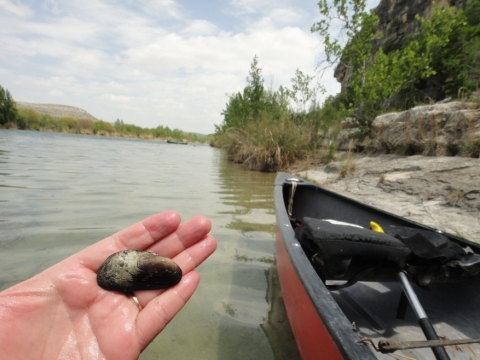
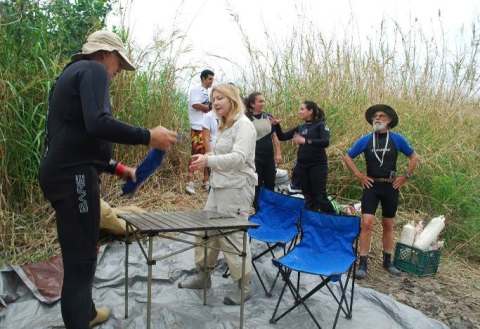
Later in April of 2012 we continued our population study at the mark-and-recapture site in La Bota (Laredo). During 3 days of hard work, we found and tagged 432 P. popeii in addition to 297 mussels marked in 2011 (Photo 3). We found that the favorite habitat for this mussel is very unique: crevices under flat boulders resting on the bedrock. This habitat provides stable substrata and flow refuges for mussels from strong currents and tremendous flooding events typical for the Rio Grande.
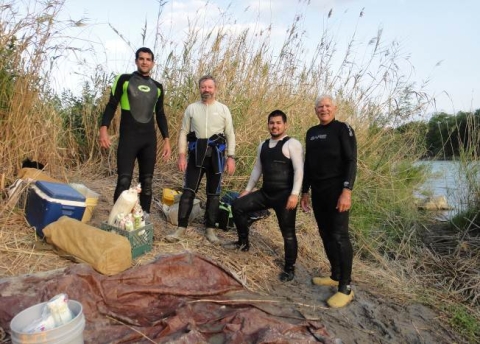

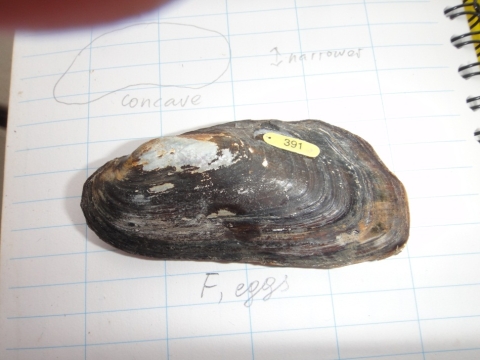
In 2012, we also surveyed 120 km stretch of the Rio Grande above and below Laredo, for the first time using an airboat, which has proved to be a great water craft for such surveys. During this survey we found an additional over 300 live Texas hornshell. Mussels were found on all 13 sites with suitable substrate in 70 km stretch of Rio Grande above and in Laredo (Photo 4). No live P. popeii were found in the 50 km surveyed stretch of river below the North Laredo and Nuevo Laredo sewage treatment plants in spite of abundance of suitable substrates. The reasons for the lack of mussels could be the contamination of water or sediments that prevent mollusc reintroduction from upstream sites.


Overall in 2011-2012 we discovered the largest (1,382 live specimens recorded) extant population of P. popeii in the lower Rio Grande River in Laredo, Texas ever reported from Texas, New Mexico or Mexico. However, it currently occupies only a small portion of its former distribution range, and the most significant threats for this population are water pollution, impoundments, salinization, and over extraction of water.
We already published one paper (Karatayev, A. Y., T. D. Miller, and L. E. Burlakova. 2012. Long-term changes in unionid assemblages in the Rio Grande, one of the World's top 10 rivers at risk. Aquatic Conservation: Marine and Freshwater Ecosystems. 22(2): 206-219) and presented three talks at scientific meetings based on the results of this study.
Lyubov E. Burlakova and Alexander Y. Karatayev. Great Lakes Center, Buffalo State College, 1300 Elmwood Avenue, Buffalo, NY 14222, USA. burlakle@buffalostate.edu; karataay@buffalostate.edu