


Great Lakes Center Newsletter: Issue 7
November 10, 2015
The Great Lakes Center is pleased to release the fall issue of our newsletter. This issue has a special focus on the Emerald Shiner project and WNY PRISMs summer activities. We feature a few articles authored by our graduate students.
Emerald Shiner Project: Year Two
by Steve Fleck, Colleen Kolb, and Jo Johnson, graduate students

The second field season of the Emerald Shiner Project has come to a close and three graduate students have joined the team: Colleen Kolb and Jo Johnson are new to the project, and Steve Fleck was previously a technician during the 2014 field season. Steve has spent the season sampling marinas for larval fish and mapping aquatic vegetation on the Niagara River. Jo worked this summer as a laboratory technician completing stomach content and stable isotope analysis. Colleen began her position in early September, and will be conducting fatty acid analysis and larval fish identification.
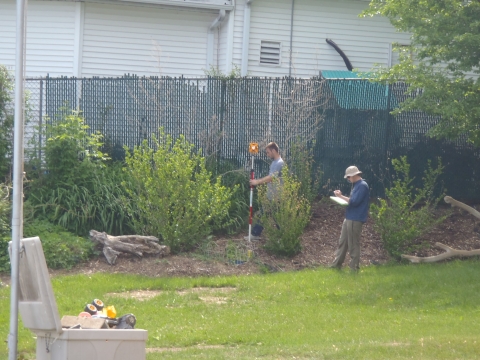
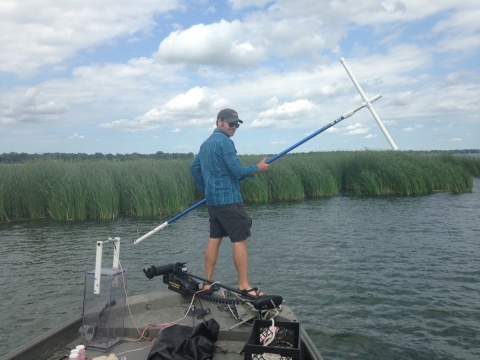
This season, a large effort was focused on mapping vegetation and substrate within shallow areas on the upper Niagara River; Steve coordinated this effort in collaboration with the Army Corps of Engineers and was joined by the University at Buffalo Ph.D. student, Brandon Sansom, who measured water velocity. The crew collected and identified plant species and used a sonar technique to map the vegetation beds. Additionally, a ponar grab was used to collect and categorize substrate.
One of the primary objectives of this project is to determine the emerald shiners’ role in the upper Niagara River ecosystem. Jo has finished up identifying the stomach contents of last year’s emerald shiners and is working now on determining the stable isotopes of carbon and nitrogen of shiners and their predators. Colleen will be working on fatty acid analysis of both the emerald shiner and its diet. With this data we will be able to get a better understanding of how fatty acids are transferred up the food web.
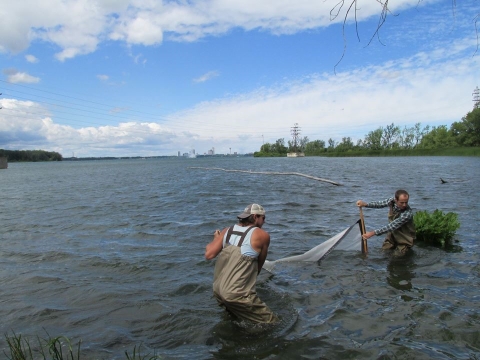
Jake, Chris, John, and Steve continued their biweekly rotation of electroshocking and larval seining throughout the upper Niagara for the entirety of the summer. In addition to their field duties, they have been collecting data for their respective theses. Jo fills in for them when needed, and Jake has been teaching both her and Steve how to drive the boats and operate equipment for next year’s field season.
This project is a unique experience because we are learning how to be independent scientists both in the field and the laboratory. As graduate students, we are expected to conduct research on our own, while also collaborating with our peers. This summer has been a great opportunity for us all to pool our knowledge, as well as encourage each other to discover new skill sets.
Please follow the Emerald Shiner project on their website or on Facebook and other social media platforms.
Lake Michigan Intensive Sampling
by Alexander Karatayev, Knut Mehler, and Lyubov Burlakova
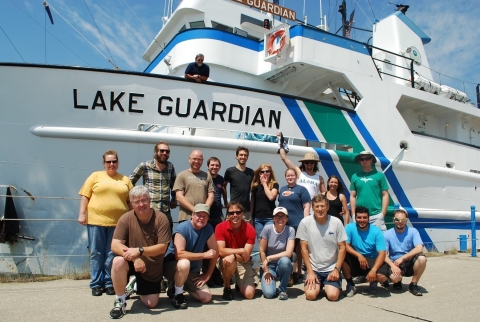
In collaboration with Tom Nalepa (University of Michigan), and Ashley Baldridge (NOAA-GLERL), researchers from the Great Lakes Center conducted the first lake-wide survey of benthic community of Lake Michigan. Studies were conducted onboard the U.S. EPA Great Lakes National Program Office boat R/V Lake Guardian. A total of 469 ponar samples were collected from 158 sites.
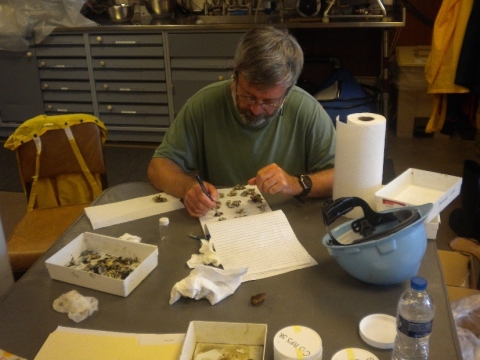
In addition, for benthic habitat assessments and Dreissena coverage estimation we collected over 500 videos with a Go Pro camera mounted on a ponar grab, and 47 videos from a Go Pro camera mounted on a benthic sled towed behind Lake Guardian. Such extensive underwater video footage was collected for the first time for Lake Michigan and will definitely assist in the estimation of the distribution and coverage of Dreissena. To convert coverage into biomass, we measured surface area/biomass relationship for 309 Dreissena druses collected from different depths during Lake Michigan sampling.
As always, it was a great pleasure to work aboard the Lake Guardian enjoying the excellent help of the crew, conversation with colleagues, and great food: the environment in which you will be very productive. Results of this study will be presented in June of 2016 at the IAGLR's 59th Annual International Conference on Great Lakes Research.
Outreach experience for Emerald Shiner Project
by Jo Johnson, GLES M.A. student
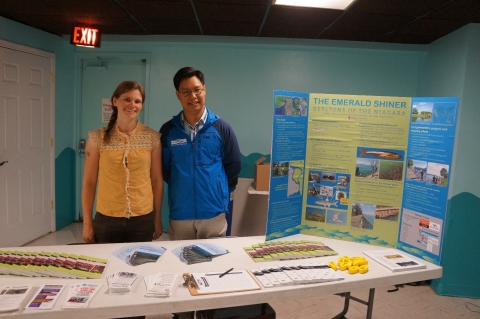
I have been working as the outreach specialist for the Emerald Shiner Project since June this year. It is an exciting opportunity for a graduate student, because it allows me to build the necessary skills for both non-profit industry work and scientific research simultaneously. As a young scientist, gaining experience in both fields at once will help me choose which career path to pursue in the future. Additionally, engaging the public about the truth behind conservation is extremely valuable in this day and age, when scientific skepticism is widespread.
For my position, I have designed a webpage which is hosted through Buffalo State. It has pictures from our field and lab work, and outlines the major objectives and purpose of this research project. In addition to the web page, we have social media accounts on Twitter, Facebook, and Instagram. This has allowed us to network with other scientists, environmental organizations, and students throughout the country. Images from our field work reach other ecologists in real time, and allow us to network with other researchers instantaneously. On a local scale, this position has allowed me to network with organizations such as Buffalo Niagara Riverkeeper, NYSDEC, New York Sea Grant, Reinstein Woods Nature Preserve and several others. I have tabled numerous environmental events over the summer, and engaged with dozens of students, local fishermen and water enthusiasts in the region.
This has been an extremely worthwhile experience for me in only three months’ time. My work as an outreach specialist has greatly improved my professional skillset, and will benefit me in my future endeavors.

GLES programs are growing
by Kelly Frothingham, GLES Program Coodinator
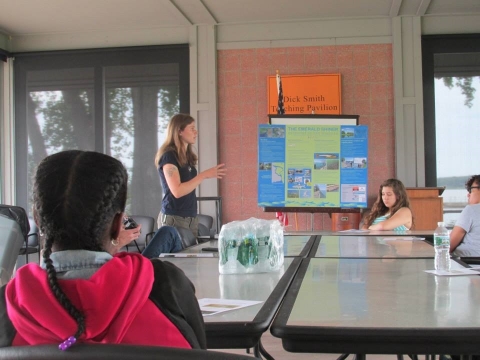
The Great Lakes Ecosystem Science (GLES) programs continue to meet or exceed enrollment projections. Fall 2015 started with two new students in the thesis-based Master’s of Arts program and five new students in the Master’s of Science Professional Science Master’s (PSM) program.
These students join several others already working with faculty from Biology, the Great Lakes Center, and Geography and Planning on Great Lakes projects and internship initiatives. Current GLES thesis research covers everything from the impacts of global warming on farming to mapping invasive species to studying fish in the lower Niagara River. Recent internships have been with Buffalo Niagara Riverkeeper and Ecology and Environment. We expect that thesis topics and internship experiences will continue to grow and expand as enrollment in the GLES programs increases.
Two students from the original 2013-2014 cohort have graduated from the internship-based PSM program and there are currently two GLES M.A. students working on finishing their thesis research with a December 2015 anticipated graduation date.
Photos



Chautauqua Lake outlet survey
by Lucy Nuessle, Invasive Species Management Assistant
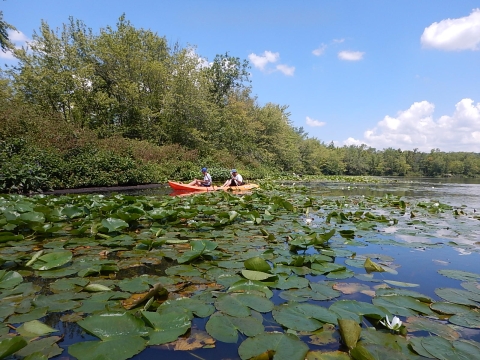
As part of WNY PRISM’s work this summer, the PRISM Crew traveled to Chautauqua County during the week of July 27th to aid the Chautauqua Lake Association (CLA) in searching for (and destroying!) water chestnut (Trapa natans) and hydrilla (Hydrilla verticillata) in the Chautauqua Lake outlet (or the Chadakoin River) which flows eastward from Celeron, NY, through the city of Jamestown, NY. Both species of aquatic invasive plants have the potential to establish dense populations that outcompete native vegetation and can limit boating, fishing, swimming and other recreational activities.
We spent the first part of our week looking for both plants in the outlet with help from a few CLA employees, their barge, and some generously donated kayaks. In order to be thorough, we spent some time surveying inlets and creeks in the area such as Goose Creek, Dutch Hollow Creek and Bemus Creek along with a few marinas. We couldn’t have asked for better weather, it was in the 80s and sunny all week! If anything, we were thankful for some cloud cover! The good news is we only found about 20 water chestnut rosettes (all found within a mile of each other within the outlet) and no hydrilla. If boaters and other residents continue to be on the lookout for these plants, they won’t have a chance to invade beautiful Chautauqua Lake.
Later in the week, we had the opportunity to help Dr. Christopher Pennuto, WNY PRISM Director and a professor of Biology at Buffalo State, search for Oriental Weatherfish (Misgurnus anguillicaudatus) in the inlets of Chautauqua Lake. The weatherfish is known to outcompete native fish for food. The DEC had positively identified a population back in 2010 in Ball Creek, so it was about time for another survey. We used a backpack electrofisher, which uses electricity to stun fish just long enough to sample fish populations. After a few hours of surveying, we found just one weatherfish in Ball Creek. While this shows they are clearly still present in the Chautauqua watershed, the population density is unclear.
We spent our last day in Chautauqua in kayaks surveying the banks of the outlet for other invasive species such as purple loosestrife (Lythrum salicaria), hybrid cat-tails (Typha glauca), phragmites (Phragmites australis), Japanese knotweed (Polygonum cuspidatum), reed canary grass (Phalaris arundinacea) and Canada thistle (Cirsium arvense). Sadly all of these species were found along the banks of the outlet, however, their populations are small enough to be managed or even eradicated. You can check out our findings at iMapInvasives. On the plus side, we did see a lot of native plants as well; such as water lilies (Nymphaeaceae spp.), spatterdock (Nuphar polysepala) and pickerel weed (Pontederia cordata) which is always inspiring! We had a wonderful time once again down in Chautauqua (both during and after work hours!) and I can’t wait until I can make it down that way again.

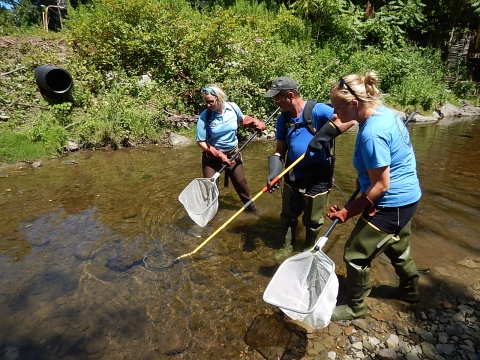
This article previously appeared on the WNY PRISM blog. Republished with permission. Photo credit: WNY PRISM.
WNY PRISM collects purple loosestrife beetles
by Andrea Locke, WNY PRISM Coordinator
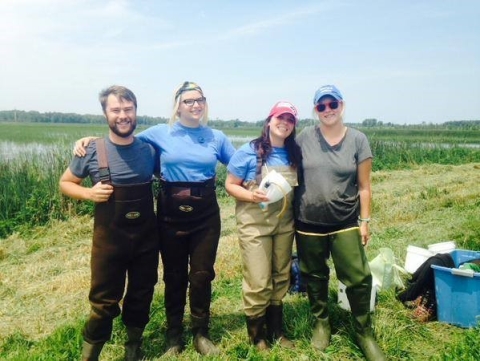
On July 7 and 8, 2015, the WNY PRISM Crew visited Iroquois National Wildlife Refuge (NWR) to help with the collection of a biocontrol for purple loosestrife (Lythrum salicaria). Purple loosestrife is an herbaceous, wetland perennial that is found in a wide range of habitats. It is problematic because it is a prolific seed producer and its large canopy suppresses native herbaceous plant cover, leading to a monoculture of purple loosestrife. This invasive plant threatens wetland structure and function by reducing native biodiversity, forage and cover.
Luckily, the use of Galerucella beetles (Galerucella calmariensis and G. pusilla) has proven to be a successful biocontrol for purple loosestrife. Since their initial release, they have become widely established where the invasive plants are present. A single female can lay as many as 400 eggs in a lifetime. These beetles are defoliators and with large enough populations, Galerucella beetles can defoliate 100% of an individual plant. Larvae feed on the underside of leaves, eating the photosynthetic tissue creating a “window-pane” effect, while adults eat straight through the leaves and shoot tips creating a “shothole” effect.
The WNY PRISM Crew was called to help our Partners collect these defoliating beetles. Assisting Denise Appleby, Frank Morlock, and Bill Wolanske, employees with the NYS Department of Environmental Conservation (DEC) who work out of Iroquois NWR, we collected Galerucella beetles from a nursery on the nearby Tonawanda Wildlife Management Area. Using an aspirator collection device, a total of twelve thousand beetles were collected over two days!
Wearing waders the group walked through marshes searching for purple loosestrife plants. By shaking the stems, all insects on the plant would fall into a collection bucket. From here, the desired Galerucella beetles were removed from the bucket using the aspirator devices. These beetles were then shipped to many organizations across the state to help combat the invasive purple loosestrife. With the number of beetles we helped to collect, DEC was able to fill all of their current orders, putting them in a great position to fill any last minute orders that come in!

This article previously appeared on the WNY PRISM blog. Republished with permission. Photo credit: WNY PRISM.
Graduate Student Bios
Steve Fleck
My name is Steve Fleck and I’m a 2011 graduate from the University at Buffalo. I graduated with a degree in Philosophy, but my true passion aligned more closely with my minor, environmental studies. After graduation I took many temporary, mainly plant-centered, positions and internships with Parks & Recreation, The Department of Environmental Conservation, the Buffalo Botanical Gardens, Ecology and Environment, and in early 2013 moved to Escalante, Utah, to do botanical work under the Bureau of Land Management. In 2014, I decided that I wanted to move back to Buffalo, NY, to pursue a master’s degree in biology at SUNY Buffalo State. After a semester of undergraduate refresher courses, I met Dr. Pérez-Fuentetaja and began working for her soon afterwards, first as a technician and more recently as a graduate student. I am applying my background in botany to explore the relationship between young-of-the-year fish and aquatic vegetation beds. I’m unsure of what the future holds, but I plan on continuing plant-related research and potentially pursuing a Ph.D.
Colleen Kolb
My name is Colleen Kolb and I am in my first year in the Great Lakes Ecosystem Science M.A. program. I am originally from Rochester, NY, and I obtained my bachelor’s degree in environmental science with a concentration in aquatic ecology and biology from the State University of New York at Brockport. While I was at Brockport I was an aquaculture assistant and conducted research on fatty acids in different species of fish. It was through these projects that my interest in aquatic organisms and their chemical make-up grew. My thesis work will focus on the fatty acid analysis of the emerald shiner.

Jo Johnson
My name is Jo Johnson and I am in my first semester as a Great Lakes Ecosystems Science (GLES) M.A. student. I was raised in the Hudson Valley, and settled in Buffalo six years ago. I graduated in May 2015 with a Bachelor of Arts in Biology at Buffalo State. I would like to research the immune response of emerald shiners that are living in sewage environments, and gather E. coli data for each site. I am an advocate of environmental conservation, and aspire to help bridge the gap between scientists and citizen activists. I hope to obtain a Ph.D. in aquatic ecology, while continuing my involvement in social outreach and engagement.
International bivalve conference a success
by Alexander Karatayev, Knut Mehler, and Lyubov Burlakova
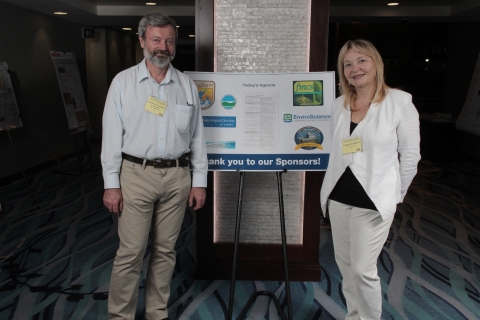
Over 80 scientists from 19 countries and four continents participated in the 2nd International Meeting on Biology and Conservation of Freshwater Bivalves hosted by the Great Lakes Center in Buffalo from October 4-8, 2015. Welcoming the attendees were Dr. Mark Severson, the Dean of the School of Natural and Social Sciences, who greeted the participants on behalf of the President of Buffalo State College Dr. Katherine S. Conway-Turner; the Mayor of the City of Buffalo Byron Brown; the Complex Manager of the Lower Great Lakes Fish and Wildlife Conservation Office Dr. Kofi Fynn-Aikins; the Great Lakes Program Coordinator Donald Zelazny; and the Director of the Great Lakes Center Dr. Alexander Karatayev.
Various important issues of the ecology and conservation of freshwater molluscs were presented, including: biology and ecology; threats and conservation needs; invasive species; biogeography and taxonomy; phylogeny and genetic diversity; physiology and reproduction; ecosystem services and functioning. Four keynote speakers contributed to the meeting with interesting and diverse talks on topics such as: Ecosystem services provided by freshwater bivalves (Dr. Caryn Vaughn); Freshwater mussels of South America (Dr. Kevin Cummings); Extinction of native molluscs in North America and introduction of exotic freshwater molluscs (Dr. Alexander Karatayev), and Global Conservation issues of freshwater bivalves (Dr. Manuel Lopes-Lima). Numerous oral and poster presentations were followed by engaging and constructive discussions and information exchange. Field trips to Niagara Falls and Letchworth State Park concluded the wonderful meeting in Buffalo.
We would like to thank our sponsors, our secretary Susan Dickinson, our photographer Dilaikshan Rajendran, technicians Kit Hastings and Josh Fisher, and graduate student Jo Johnson for their help.
